The Object of the Crime, Colony, The Virtuoso: new releases at the cinema this week
What to see in theaters
THE EVENT
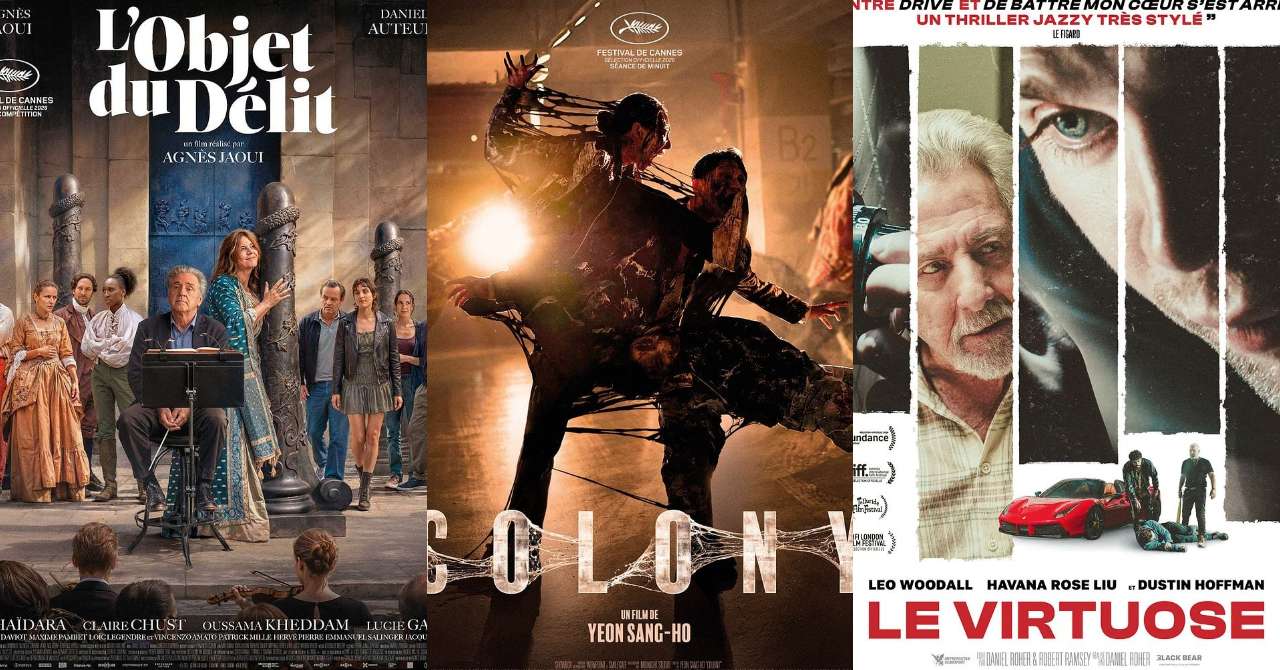
THE OBJECT OF THE OFFENSE ★★★☆☆
By Agnès Jaoui
The essentials
For her first film written without Jean-Pierre Bacri, Agnès Jaoui signs a biting comedy rich in nuances around the #Metoo movement. All this, with the audacity of not trying to round off the corners.
Agnès Jaoui chose to tackle a subject where, on paper, there are only blows to be taken: the Metoo movement. In this case, behind the scenes of a production of the opera “The Marriage of Figaro” where tensions rise within the members of the team when an accusation of sexual assault arises, forcing everyone to take a stand. Agnès Jaoui proposes, not without ambition, to add nuance and doubts where the fiercest opponents of the two camps confronting each other on this question have only certainties. And here we find everything that makes Jaoui’s cinema unique: this biting but never mocking humor, this scalpel look at the society that surrounds him, a sense of casting mixing different families of cinema without partisanship. No room here for a soothing speech. The Object of the Crime establishes the observation that, like the French left, there undoubtedly exist today two irreconcilable feminisms. The object of the crime will not be unanimous. The best proof that its director hit the right note
Thierry Cheze
Read the full review
PREMIERE LIKED A LOT
ON ARM-LE-BODY ★★★★☆
By Marie-Elsa Sgualdo
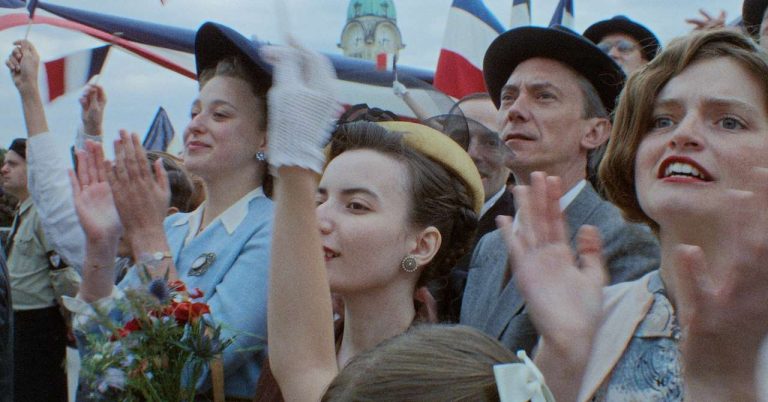
In 1943, fifteen-year-old Emma is about to receive the Virtue Prize from her village in the Swiss Jura, which could help her finance her nursing studies. It was before her rape by a passing journalist, before the resulting pregnancy, before her destiny slipped through her fingers. Marie-Elsa Sgualdo offers here a film in the form of a beautiful escape, whose direction and settings mature and evolve as her heroine’s personal revolution progresses. Emma takes flesh before our eyes in a learning story carried by Lila Gueneau who, with large dark eyes straight out of a master’s painting, signs an extraordinary performance of restraint, surrounded by male figures to whom the author-director gives the gift of nuance, intelligently avoiding the pitfall of Manichaeism.
Chloé Delos-Eray
Read the full review
FIRST TO LIKE
COLONY ★★★☆☆
By Yeon Sang-ho
You thought you’d seen it all? Since Romero locked his survivors in Zombie’s shopping center, we have been treated to the sprinters of Boyle, the industrial hordes of World War Z… The genre has become so diluted that there is not much left to sink our teeth into. Even South Korea got into it with Last Train to Busan, very effective, but which still stuck too closely to the specifications. And now its director Yeon Sang-ho returns with a proposal that dusts off the formula. Colony traps its characters in a Seoul tech skyscraper. A scientific conference turns into carnage and the survivors will have to play a bloody game of chess. It’s Die Hard meets Zombie, with infected people no longer just mindlessly biting. Here they learn. They first crawl like animals, then coordinate and organize themselves into collective intelligence. Yeon Sang-ho films it like a horrific ballet and transforms the action into a strategic duel. Colony succeeds in doing something new with zombies.
Gael Golhen
Read the full review
EVERYTHING IS GREAT ★★★☆☆
By Patrick Cassir
After the schoolboy comedy (First Vacation), time for the moving comedy. Inspired by what he went through, Patrick Cassir portrays Sylvaine, a mother whose overwhelming love for her son, Elie, prevents the latter from living his own stories of the heart. Because the illness that is gnawing at her increases his guilt for the good time he can spend away from her. Cassir finds the right tone to tell the story of this duo which will quickly become a trio when Elie, in a moment of remission from Sylvaine’s cancer, falls in love with Anaïs to whom he will not be able to admit the sudden reappearance of the illness in his mother’s life. A perfect balance between laughter and tears which owes a lot to the finesse and amplitude of the interpretation of its actors, Noémie Lvovsky and Marie Colomb in the lead. But also Rudy Milstein (co-writer of the film), irresistibly funny in the role of the young man hired by Elie to stay with his mother on a daily basis. It deserves a film of its own!
Thierry Cheze
THE VIRTUOSO ★★★☆☆
By Daniel Roher
A piano tuner who is extremely gifted in his job discovers that his perfect pitch also allows him to open safes without much effort. His old partner played Dustin Hoffman in need of very expensive medical treatment, the tuner joins forces with a gang of burglars… So much for the score of Virtuoso, which director Daniel Roher (Oscar-winning documentary filmmaker of Navalny) plays on a cool and jazzy rhythm à la Soderbergh, mixing thriller, romance, and portrait of an endearing character, whose hyperacusis (an auditory hypersensitivity) forces him to live cut off from the world, somewhere between Baby Driver, Will Hunting and Rain Man (quoted in dialogue, in a nod to Hoffman). The strings of the detective intrigue are sometimes very big, but the film has charm, just like its hero Leo Woodall, a handsome guy revealed on TV (The White Lotus), for whom this Virtuoso is supposed to serve as a cinema launching pad.
Frédéric Foubert
COCOTTE ★★★☆☆
By György Palfi
Filming at the height of a little black hen could be a useless artifice. There is absolutely nothing here. Better still, the Hungarian György Palfi (Taxidermie) offers a feature film as singular as it is epic, as political as it is tragic, while also providing a few funny breaths to the best effect. The first half of the film resembles a road movie that could have taken the form of a Flow-style cartoon. The aforementioned cocotte, determined to escape the disastrous fate of industrial breeding, experiences a real epic strewn with pitfalls likely to make her lose a few feathers. Before the film gradually turns towards drama as the young bird is adopted by an old man in a small rickety restaurant on the Greek coast. There, seeking at most to preserve her eggs but also her freedom, she is – like the donkey in Skolimowski’s Eo (2022) – the involuntary witness of the vicissitudes and other compromises of humans, of their small and large arrangements with the laws and their inevitable consequences. Rather than giving in to the call for computer-generated images to embody his heroine, the director preferred to enlist the services of… eight identical chickens, of a confusing naturalness and particularly expressive. A bold but particularly rewarding choice which contributes to the realism of the film and its charm.
Anne Lenoir
FATHER ★★★☆☆
By Tereza Nvotova
While the day promises to be extremely scorching, the kind that should not be left in direct sunlight, and even less so in the overheating cabin of a car, Michal is convinced that he has dropped Dominika, his two-year-old daughter, off at daycare. However, a few hours later, when Zuzka, his wife, showed up to take her back, the little girl was not there. The couple who seem to succeed in everything suddenly fall into horror. For her third fiction feature film, Slovakian Tereza Nvotova has chosen to adapt for the screen the unspeakable drama experienced by one of her acquaintances. And offers a sensitive and fair film, without passing judgment against this neglectful father in spite of himself, forced to face his grief, but also that of his wife, under the necessarily accusatory gaze of public opinion. Long sequence shots but also meticulous work on the sound immerse the viewer in the chaos experienced by such an ordinary couple.
Anne Lenoir
THE LAST BREATH OF A YAKUZA ★★★☆☆
From Baku Kinoshita
Deep in his cell, a yakuza is dying. At the time of remorse, a small plant which witnessed a large part of his life, arrives to remind him of the “rotten life” he had. In an unpredictable dialogue, both will retrace the course of his existence, as if to understand (more than justify) how one comes to choose the life of a yakuza, carried by a pure love for his wife and his adopted son. In contrast to an overloaded and frenetic animation, The Last Breath of a Yakuza aims for purity (the drawing charms above all by its simplicity), the moral complexity of the criminal – the first victim of the system he “chose” to embrace. If the dialogue between the flower and the yakuza refers to an entire dialectical tradition, the film also moves with its gentle frontality. What if this man only sought repentance with the objective of dying in peace with himself, purged of his “rotten life”?
Nicholas Moreno
Find these films near you thanks to Première Go
FIRST TO MODERATELY LIKED
HOLLY DESTRUCTORS ★★☆☆☆
By Aistė Žegulytė
Not really a documentary, not really a museum work, Holly Destructors will be a chimera of the two, an object as unusual as it is elusive. Through this circular image format which imitates vision through a microscope, filmmaker Aistė Žegulytė encourages us to examine with a magnifying glass the infinitely small (the fungi which damage works of art) and, at the same time, the inevitable passage of time. There is something almost unreal in this Memento mori disguised as a film. Between a few austere scenes of restorations and religious ceremonies, the accelerated evolution of these fungal microorganisms hypnotizes us, their formal beauty moves us. But the slap will remain purely visual. As ingenious as it is, the Holly Destructors device very quickly mutates into a monotonous slideshow. The ambition was too colossal, the subject too microscopic, and the meeting of the two was boring.
Lucie Chiquer
FIRST DID NOT LIKE
THE BRIDGE ★☆☆☆☆
By Walid Mattar
The initial premise is not remarkable: on the set of a music video in Tunis, three lost thirty-somethings – a pseudo rapper, an aspiring director and a student who plays influencers to make ends meet – come face to face with a package full of cocaine. Should we inform the police or throw it into the open sea? The trio opts, despite themselves, for the third option: the development of a drug deal in a posh nightclub, beyond the Radès bridge which they cross every evening to escape their suburbs. Drowned in a lazy script and amateurish execution, the social message of Tunisian youth in distress but carried by the illusion of a better life quickly falls flat. The actors do their best, although they would have needed characters to match the comic subtext. Imagine Five, but less funny and sloppier.
Lucie Chiquer
And also
The Coyote, by Katherine Jerkovic
Cuba & Alaska, by Yegor Troyanovsky
Mata, by Rachel Lang
Pauline, reversible, by Keven Hamon and Renaud Cathelineau
The covers
French connection, by William Friedkin
The Man Who Would Be King by John Huston
Gentlemen Prefer Blondes by Howard Hawks
Macho dancer, by Lino Brocka