
Annecy 2026: Minions and monsters, a declaration of love for silent cinema (review)
Presented at the opening of the 50th Annecy festival, the seventh opus of the franchise sends the yellow capsules into 20s Hollywood. Pierre Coffin signs his first solo production and a declaration of love for cinema.
Welcome to the Hollywood of roaring twenties ! The seventh episode of the franchise Despicable Me sends the yellow capsules to the origins of American cinema, to the time when Universal – the house which produces them, by the way – was inventing its founding monsters. At the opening of the 50th edition of the Annecy festival, Sunday evening, in front of Guillermo Del Toro who came to shout a resounding “Fuck AI!” in the room, the screening of Minions and monsters had something of a manifesto. Pierre Coffin is in fact his first solo feature film, the only one that he has been able to co-write from start to finish with Brian Lynch. “It’s the first time that Chris (Meledandri Editor’s note) really let me do my thing”he told the magazine.
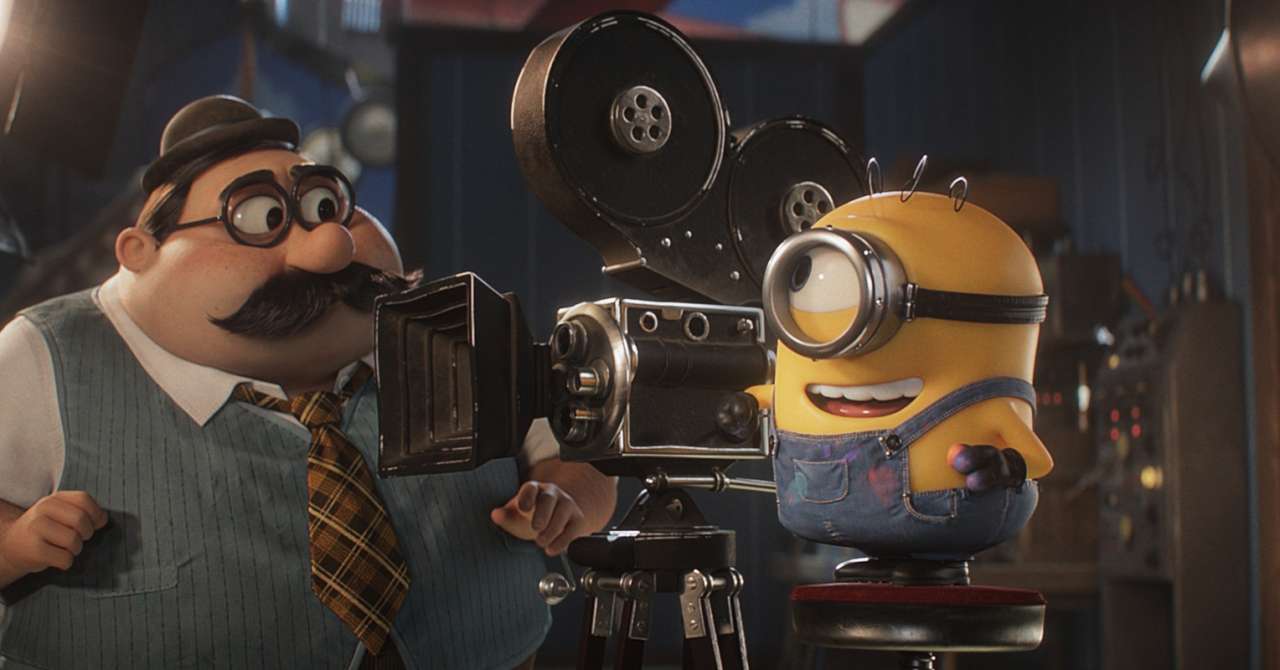
And “his thing” is therefore a declaration of love for cinema. James, Minion dreamer and apprentice filmmaker, his sidekick Henry and their mute companion Ed arrive in Hollywood in the 1920s, shoot their first films, become stars of silent films, before the talkie (necessarily) puts an end to their dream of glory. To bounce back, James decides to shoot a big monster movie and inadvertently summons real evil creatures. The process is amusing: it is the Universal house which goes into abyss, summoning its own bestiary of freaks – we come across the Mummy, the Strange Creature from the Black Lake – under the fluorescent filter of contemporary animation. The gesture is also assumed visually from the start: the film opens with the contemporary Universal logo which rewinds to the 1920 logo, and the Illumination bug is itself revisited in the style of a Fleischer brothers cartoon.
Universal plays at Universal
The result oscillates between a cinematic homage and a proven recipe. Coffin masters his slapstick choreography and the winks give the episode a fun meta veneer. We are treated to a cameo from George Lucas, exhibited as a living attraction in a Hollywood museum and lending his own voice to a tasty running gag; we meet Chaplin who reenacts a scene from Modern Times with minions, Harold Lloyd who emerges as a specter of the mute; Coffin enjoys hijacking a cult sequence from Citizen Kane and multiplies the pastiches of Singin’ in the Rain. A small single-key director called Max, a self-confessed composite of Fritz Lang and Ernst Lubitsch, and two pot-bellied producers complete the picture…
The film has two heads
It is there, however, that Minions and Monsters becomes a little wobbly. Throughout its first part, the film resembles an unusually free project: we follow the friendship of James and Henry, their rebellion against the yellow horde, their first emotions as filmmakers, their awkward tenderness. The emotion comes to the surface, and this is where the story allows itself cinephile digressions. And then, around halfway through the film, the monsters show up and banana fan service regains its rights, the parallel stories hang together like wagons (the character of the B series robot), and the pace becomes hysterical. As if Coffin had taken his personal declaration of love as far as he could, before putting the film back on the track imagined by the studio.
The obvious remains: for fifteen years, Illumination has been producing pop animated films with impeccable graphic quality. And if the Minions are the mascot of an industrial and conscious animated cinema, Coffin is never fooled. This seventh opus should continue to make the family laugh – with, as a bonus for parents, the thrill of having recognized Lovecraft in a joke. It’s already not bad.


