
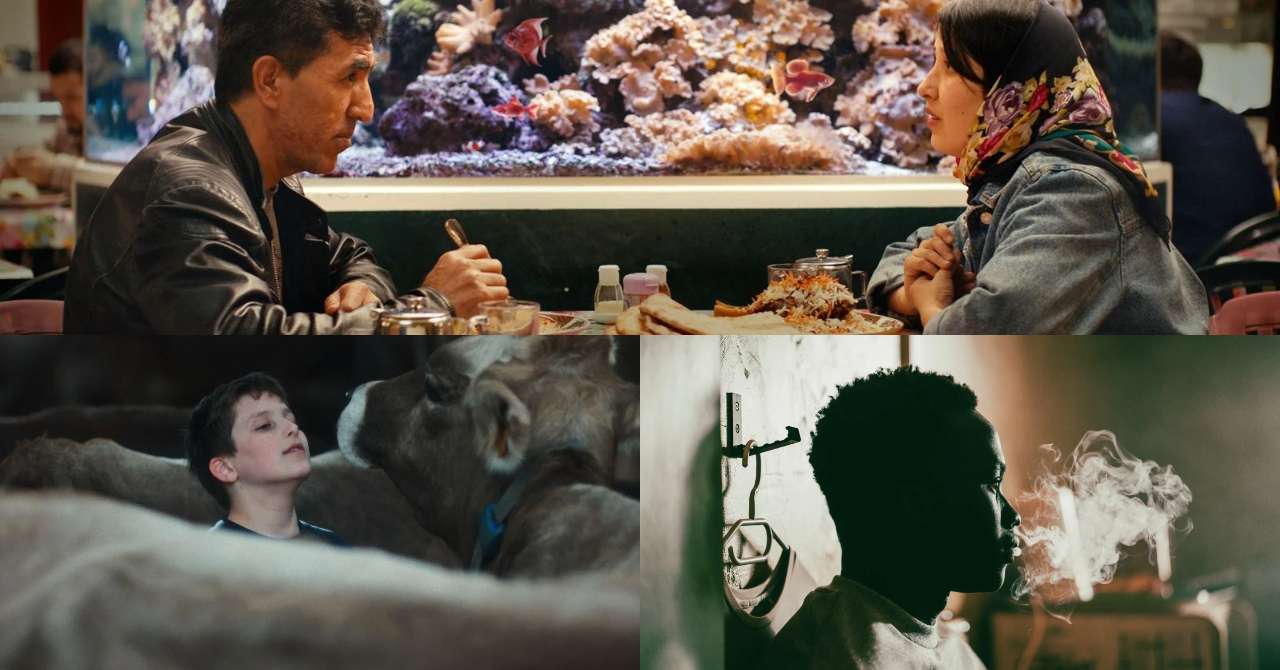
Nouvelles Vagues – day 2: No good men, Gabin and Ashley Walters
Every day, a look back at the highlights of the 2026 edition of the Biarritz festival dedicated to stories highlighting youth
Film of the day: No good men by Shahrbanoo Sadat
A fighter? Better: a fighter! In the Kabul of 2021 on the verge of seeing the Taliban regain power, Naru, who is raising her child alone after daring to break up with her unfaithful husband, is the only female cameraman on the main Afghan television channel. And continuing to undermine the “glass ceiling” solely linked to her gender, she succeeds in accompanying the channel’s star journalist, Qodrat, into the field, anything but thrilled at first by her presence. Without suspecting that Cupid will invite himself to their side and give birth to a love story rich in complications, Qodrat being in a relationship. Telling the story of the lives framed up to the suffocation of women in Iran through the prism of a romantic comedy is a bold move.
But holding this line to the end without politics taking precedence over everything else speaks to the talent of its director – who also plays Naru – and whose first feature we were won over by, Wolf and sheepit’s been ten years already. Shahrbanoo Sadat excels here in his way of showing the oppression experienced by women in small touches, without ever adding to it. Here, an interview that ends abruptly because of an ill-fitting veil. There, the paternalistic attitude of a police officer during a traffic stop. But it also shows everything that being a woman offers that is unprecedented in a locked-down and misogynistic society, as when Naru is the only one who can collect women’s secrets about life as a couple during micro-sidewalks, the latter refusing to confide in men. No good men hits hard and just because it is never demonstrative until its poignant final straight line when the Taliban once again become the masters of the country. Since then, the nightmare has only gotten worse for women
In theaters February 3, 2027
Today’s documentary: Gabin by Maxence Voiseux
In 2014, for his graduation film from the University of Paris VII, Maxence Voiseux met a man on the cattle market in the city of Arras who opened the doors to his family, the Jourdels. An immersion which will give birth to a short (Men and beasts), a medium-length film (The Heirss, centered on the three sons of this patriarch) and therefore this first feature for which he followed Gabin from the age of 8 to 10, the youngest of the Jourdel family destined to take over his father’s butcher shop. Perfect cross between Boyhood And The Bertrand Farm, Gabin captivates by its ability to keep it short (1h40 for ten years of life!) – with therefore drastic choices in what it shows and hides (we never see its two big brothers for example) – and the fluidity of its ellipses.
Without explanatory voice-over but with judicious use of music, this film reveals itself above all to be a wonderful story of anticipation about a young man torn between his desire to travel the world and the family loyalty that pushes him to stay to take back and save his mother’s farm. Never didactic, Maxence Voiseux succeeds here in describing and transmitting with the same virtuosity the complex relationships between this son overflowing with life and desires and his loving but silent father, the crisis of the rural world and the exchanges on their respective crushes of Gabin with his best friend. We are amazed from start to finish by the way in which he was able to make those they film forget his camera and create between each of them and us, the spectators, an immediate bond that will never be broken. A joy of a film.
In theaters November 18
The revelation of the day: Ashley Waters, director ofAnimol
We obviously know the actor Ashley Waters. Heroes of the series Top boywe saw it in the cinema in Succeed or die by Jim Sheridan and Tomorrow it all begins by Hugo Gélin and more recently in two episodes ofAdolescence. But with Animolhere he is in his forties on the other side of the camera. With a story that at first glance you think you know by heart, immersed in the brutal daily life of a detention center for young delinquents. But Animolgoes beyond a simple prison film by bringing about an unexpected love at first sight between two of the young inmates.
And if this queer dimension takes us by surprise, it nevertheless turns out to be anything but gratuitous. Because beyond the blackmail to which the two lovers will be victims as soon as their secret affair is discovered and the ambient homophobia which fuels it, Ashley Walters describes above all with great accuracy the way in which shame overwhelms one of the two main parties, locked up between the four walls of a prison even larger than this center for juvenile delinquents. That of masculinity which does not tolerate any side step and corrupts the minds to the point of reducing the impulses of the heart to almost nothing. All without miserabilism and always seeking to keep intact the flame – however small – of hope. Successful beginnings
Undetermined exit


