Annecy 2026 – Enrico Casarosa: “Nero brings painting into Pixar animation” (interview)
On the occasion of the Annecy International Animated Film Festival, Enrico Casarosa, to whom we owe Luca, presented the first images of Nero, the next original feature film from Pixar. The Italian filmmaker imagines the adventures of a Venetian black cat, in a visual universe that deliberately breaks with the traditional photorealism of the studio.
From a purely technical point of view, to what extent the quasi-pictorial rendering of Nero could have seen the light of day even five years ago?
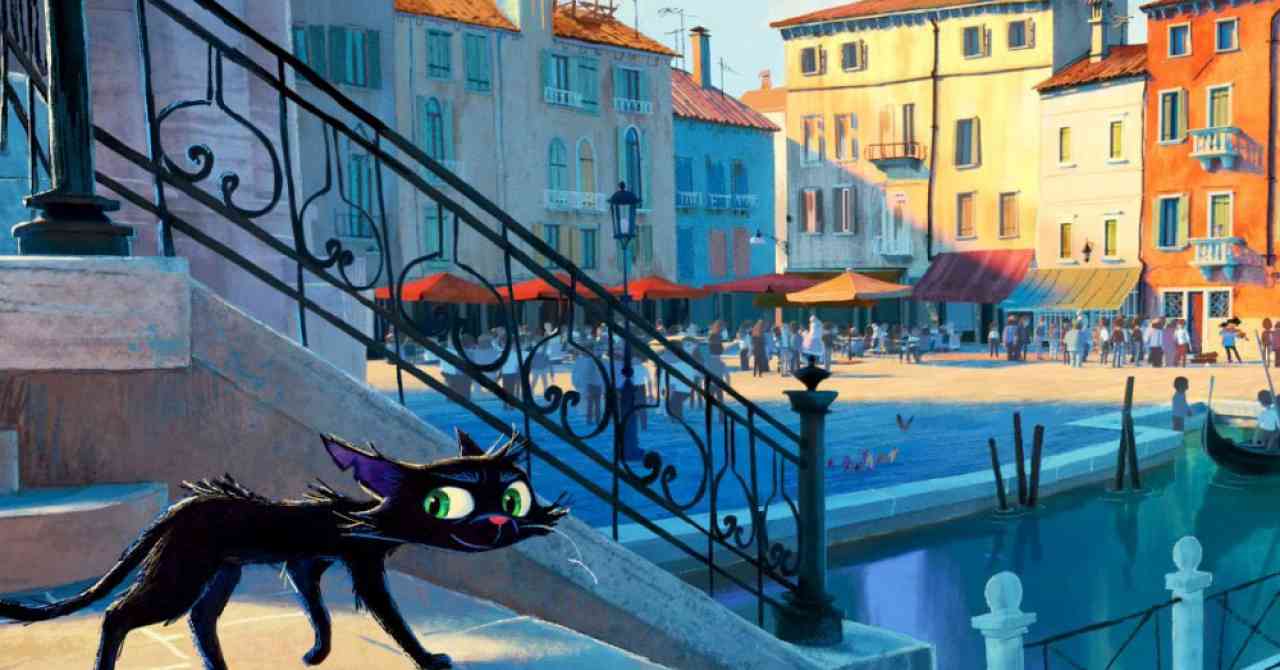
Enrico Casarosa: When I made the short film La Lunaaround fifteen years ago, I already wanted to give the characters more artisanal, more handmade textures. Back then it was much more difficult. The computer naturally tends to produce very three-dimensional, very photographic images. For Gattoso we had to, in a way, “break” our tools. Usually we place materials where they need to be and then design lighting to mimic the real thing. Here, we wanted to move away from this logic.
We decided to paint light and shadow. These are no longer just physical phenomena: they are textures, graphic choices. The lighting teams therefore work differently. For example, we can light the same decor twice, with a light version and a dark version, then very precisely modify the color of a shadow or an area of light. Gradients have almost become our enemies! We seek to make each element more graphic, more textured, more sketched. It’s very stimulating to think about everything you can do to recapture the feeling of a drawing or painting.
For years, it was thought that traditional, hand-drawn animation was almost dead. Today, it seems to be returning via computer-generated images. Paradoxical, no?
Yes, it’s interesting. It’s not enough to want to “do animation” for it to work: you also have to create an immersive experience, offer something new. We are obviously inspired by the idea of the gesture, of the trace left by the hand. Take special effects: in many films, they rely on particles, on very physical simulations carried out with software like Houdini. On Nerothe teams sometimes draw the splashes, experimenting with 2D animation. For some artists, this is a first.
There’s something very exciting about shaking up habits and then finding a way to reintroduce those ideas into existing tools. The best talents are often attracted to what is new, difficult, and what gives them the opportunity to learn. We have a great team, willing to accept that we don’t have to master everything right away.
And you didn’t make it easy for yourself by setting the action in a real city, Venice, which forces you to respect the reality of the place.
We made several scouting trips. We would go away for a few days with members of the team to observe, draw, photograph and record everything we could. With LucasCinque Terre was less familiar territory for much of the public. Venice, on the contrary, is known all over the world. The challenge is therefore different: we must avoid the postcard, the expected point of view. So we looked for more unique angles. The way cats look gives us real freedom: they live at ground level, slip into unexpected corners, observe the city from places we don’t think about. And even when a place is recognizable, we can treat it differently through color, light or expressiveness.
What excites me is thinking of these images as paintings. Emotion must guide the way we represent a moment. Color, light, composition can convey a precise feeling. There is something impressionistic about it: less the exact reproduction of a place than the sensation it provokes.
It’s become a bit of a custard pie, but I feel like a movie like Nero could not have seen the light of day without the revolution of Spider-Verse on the industry.
They clearly shattered some frames. Their link with comics, their way of using different visual universes… It was extremely powerful. They showed that a film could assume a very assertive style while remaining totally immersive. But they are not the only ones. My daughter is a big admirer ofArcanaFor example. It’s wonderful to see that different stories can be served by different styles. With Lucaswe were already trying, on our scale, to go in this direction, to see how far we can push a graphic identity while remaining faithful to the story.
Today, there is greater open-mindedness. The question is no longer just: “ How to make something beautiful? “, but also : ” How to make it unique? » Of course, the style should always be linked to the world and story of the film. The real challenge is finding your own way, not imitating that of others.
For a long time, we could immediately recognize a Pixar film visually. This identity is much broader today.
I agree and I think we need to continue to broaden the spectrum. It’s not just about style but also about choice of story. Lucas already represented, for me, a way of telling a more personal, slightly different story. Every film must be guided by what it seeks to tell, and there are some very exciting projects at Pixar that are moving in this direction. At the same time, we are also making sequels, and that is another challenge, because we have to find a strong story in an already very developed universe, with characters that the public knows very well. This requires another form of creativity.
The studio has gone through several periods of transformation in recent years. But I feel like a line is finally starting to emerge.
It’s difficult to perceive from the inside. On the other hand, we are very aware that it has become more complicated to attract audiences to theaters with original films. We want to continue to convince spectators to leave their homes to live a collective experience, both with sequels and with new creations. I know that Nero is a daring bet, but I hope that its visual universe, its music and its atmosphere will make the public want to discover it in the cinema.
Pete Docter has run the studio for several years. He’s a filmmaker himself, and it’s a special position to go from director to head of an entire studio. I worked with him on Up there and I learned a lot alongside him. He’s someone I really admired when I was starting at Pixar. I am rather introverted, too, and seeing him succeed in imposing his voice made me think: “ Maybe I can do it too. » He knows how to leave the directors with their film, their story, their uniqueness, while providing feedback and giving direction.
The starting point of Nero was it really born from observing the cats of Venice?
Yes ! I have a special connection with Venice. I spent several summers there, thanks in part to friends of my wife’s family. I love this city deeply, and I have always loved drawing it. I fill sketchbooks with pencil and watercolor; I even published a book, The Venice Chronicles.
When you spend time in Venice, you notice the cats. There used to be more of them but they have an incredible presence. They seem to rule the place, very sure of themselves, always sneaking somewhere. We immediately wonder what they are up to. One of my first drawings showed a cat holding another cat by the paws, over a bridge. There was already this idea of rivalries, of gangs, almost something Dickensian; with street cats who must fend for themselves to survive.
Then came the idea of a black cat. When you are a black cat, loaded with superstitions, at the end of your rope and in difficulty, you can easily become very individualistic, entirely focused on your survival. I found it interesting to place a character like Nero opposite someone else who is also struggling to find his place in the city. The film has become a sort of con artist story, with a character who pretends to be nice, but whose first instinct is to steal your violin (Laughter.). The big question is what could push such a selfish character to make a choice that doesn’t directly serve him/her?
Music also seems essential in the film.
Yes, that’s the other big part of the story. We haven’t revealed everything yet, because we want to preserve some surprises, but Nero has a very special relationship with music. We see it in particular through his tail, which moves of its own accord: he has music in his bones, without really being able to control it.
Venice has an extraordinary musical history: Vivaldi, opera, Goldoni… It is a city deeply linked to music. The arrival of Maya, a violinist from the Balkans, creates an interesting contrast with the heritage of classical and baroque music. Nero finds himself at the center of this encounter and must learn to hear, understand and appreciate this world. This is often how films are born, with two or three distinct ideas that end up colliding and, sometimes, creating something unexpected.
We still have to talk about the pigeon, hilarious, and that you overtake yourself…
Ah ah ah! There had to be a pigeon in our Venice, since they are everywhere. And I absolutely wanted it to be extremely Italian. We started joking around wondering if he might be part of a union. But what could he possibly claim? The anti-pigeon spikes were a natural choice, because they are really present everywhere in the city.
This is how Saverio was born. He is very proud to be Venetian and loves his city deeply, unlike Nero. Saverio cannot understand this because for him Venice is the most beautiful city in the world, and he is almost offended by Nero’s vision. Initially, I simply lent my voice to the character during the work sessions, a temporary voice. Then people started laughing… Someone finally told me I should do it. When looking for a voice for an animated film, certain roles are essential and others are difficult to cast. In this case, we were having so much fun with the character that it all happened naturally. It’s very strange today to see the animators bring it to life and to hear my voice coming from this bird. But it is also an honor. I think I needed others to tell me to do it, because I probably wouldn’t have dared to decide it alone!
Nero, March 3, 2027 at the cinema.


