Benedetta on Arte: Paul Verhoeven organizes enjoyable chaos (review)
A new portrait of an elusive woman, told in a form torn between academicism and iconoclasm.
On Sunday, Virginie Efira received the best actress prize at Cannes, shared with Japanese actress Tao Okamoto for their performance in Suddenly by Ryusuke Hamaguchi. Luckily, we find her this evening unencrypted on Arte in Benedetta (also visible in streaming on Arte.TV). She plays a 17th century nun in this film by Paul Verhoeven, one of the most striking roles of her career which won over the editorial staff of Première when it was released in 2021. Our review:
Paul Verhoeven: “Benedetta does not respond to a trend or a political gesture such as #MeToo”
There is something of Luis Buñuel in the journey of Paul Verhoeven. Not only because of his taste for provocation, his never-ending desire to shock the bourgeoisie, but also for his ease in moving from one film industry to another, from one era to another, from one style to another, without ever losing his identity along the way. Bunuel was in turn a Parisian avant-garde in the 1920s, a director of melos in post-war Mexico, a revered author directing the biggest French stars of the 60s and 70s? Verhoeven’s journey echoes him, the “violent Dutchman” having also spent his career metamorphosing.
First a leader of Dutch cinema in the seventies, then the creator of gleaming blockbusters in Hollywood, here he has recently been reinvented, to everyone’s surprise, when people no longer thought highly of his career after the long silence which had followed Black Book, as a filmmaker from home, shooting Caesar-winning dramas with Isabelle Huppert. His logic of dynamiting American cinema had gone so far, with Showgirls then Starship Troopers, that Hollywood decision-makers had asked him to look elsewhere. The French enjoyed seeing him twist the clichés of French cinema so much in Elle that they asked for more.
This capacity for adaptation, which almost resembles entryism, is quite impressive, and, after Elle, here is Benedetta, still produced by Saïd Ben Saïd (the great architect of this artistic resurrection), who offers herself to us in very chic “César film” clothes: luxurious casting led by the biggest female star of the moment (Virginie Efira), sumptuous period reconstruction… Benedetta has the makings of a major historical production capable of seducing the Academy, somewhere between Tavernier, The Name of the Rose and the late Polanski.
But to speak of academicism would be going a little too quickly, the film at the same time fully maintaining its program of a lively and wild “Verhoeven movie”, nourished by anticlerical anarchism, stuffed with shocking scenes, blithely stripping its actresses, in a pandemonium which does not really resemble the generality of cinema here either. One foot in, the other out, Verhoeven adapts to the habits and customs of the country that welcomes him, while driving home the point of very personal obsessions, with a sardonic smile on his lips.
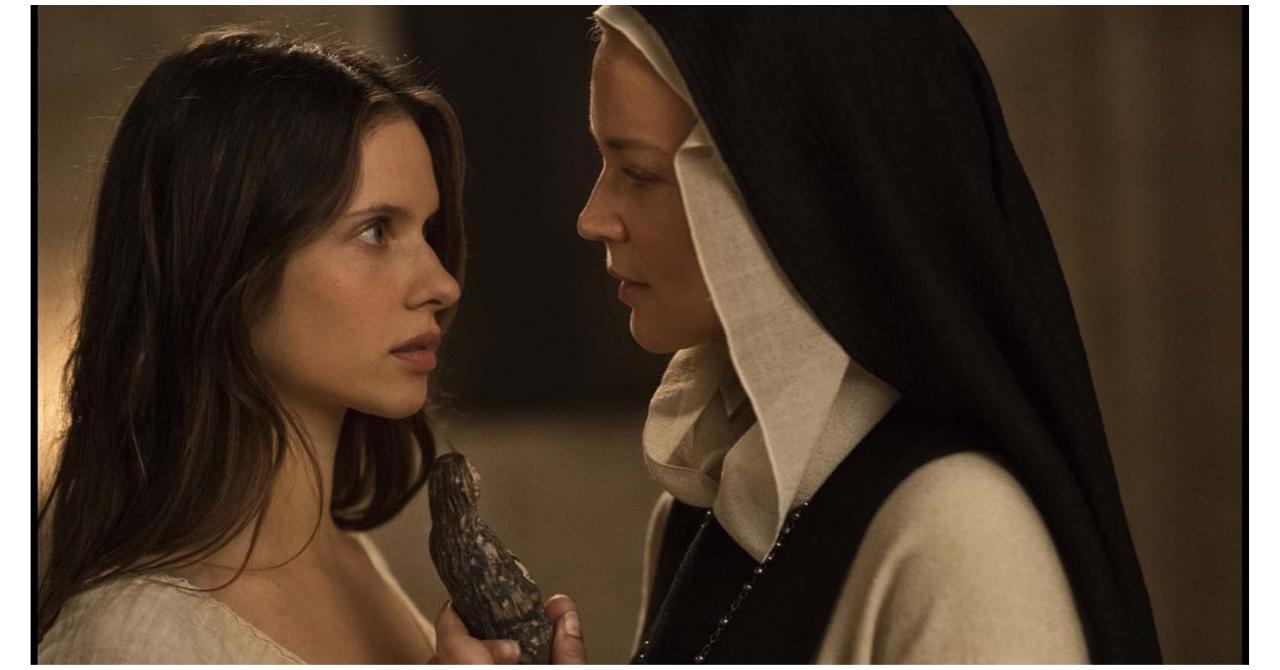
But let’s start again: at the origin of Benedetta, there is a book by Judith C. Brown, Sister Benedetta, between saint and lesbian, which Verhoeven introduced to her old screenwriter friend Gerard Soeteman. The work recounts the life of this 17th century Italian nun who, at the convent of Pescia, in Tuscany, regularly fell into mystical ecstasies, conversed with Jesus, was taken for a saint, then suspected of being a fabricator, before shocking the religious authorities when her sexual relations with another sister of the convent, Bartolomea (played in the film by the astonishing Daphné Patakia), were discovered.
Virginie Efira: “I was ready to follow Paul Verhoeven with my eyes closed”
Verhoeven found there the material for a new portrait of an elusive, impenetrable woman. A sister to Jennifer Jason Leigh from Flesh and Blood, Sharon Stone from Basic Instinct and Isabelle Huppert from Elle. Is Benedetta lying (to herself and to her superiors) when she describes her encounters with Christ? Does she manipulate to climb the ladder of power and then abandon herself with impunity to the pleasures of the flesh? The first time she enters a trance, in any case, is during a theatrical performance, with Verhoeven immediately suggesting that her visions are perhaps a decoy, a staging. Or perhaps the consequence of religious practices first thought of as a spectacle.
With his usual irony, the filmmaker does not decide. What fascinates him deep down in Benedetta, as in all her heroines, is their ability to maneuver and survive in an unfair, violent, authoritarian world. It doesn’t matter whether the nun is lying or sincere, as long as she resists and asserts her freedom. And that she has, in the process, a little pleasure.
It’s an excellent story, in a historical and romantic register à la Black Book, which Verhoeven tells in a fairly controlled crescendo, served by actors in great form (Lambert Wilson is tasty as a faux-derche Nonce and Charlotte Rampling, as a skeptical abbess, finds the poisonous aura of her great roles). Rather talkative, the film initially has a little trouble getting off its hinges, with Verhoeven sometimes struggling to find exciting visual solutions to energize explanatory scenes, setting in motion very rich thematic material – which is necessarily disappointing coming from a filmmaker whose best films have always been carried by a form of barbaric excess, and gave the impression of springing from him in an instinctual and uncontrolled way.
But Verhoeven searches, tries, occasionally summoning visions of glowing skies à la Mario Bava, and ending up unleashing himself in the last act, where the multiplication of characters and adventures (in addition to Benedetta’s trial for lesbianism, the plague epidemic threatens at the gates of Pescia) allows him to tear the seams of the costume film for good. Without, of course, rediscovering the terminal furia of Flesh and Blood (his masterpiece in the medieval register and, without doubt, his masterpiece in short), he organizes a joyful chaos, where his iconoclastic ways triumph. His provocations will sometimes seem a little easy (the statuette of the Virgin transformed into a sex toy), but, after all, he has never been known for being tricky.
In one of the first scenes of the film, we see a street show, where an actor perched on a stage is pursued by attackers dressed as skeletons. The man farts on a torch to make flames burst out and thus repel his adversaries. The crowd laughs and asks for more. Paul Verhoeven, moralist as well as entertainer, is like this public entertainer. At 82 years old, he continues to be on fire.
Benedetta. By Paul Verhoeven. With Virginie Efira, Charlotte Rampling, Daphné Patakia… Duration 2h06.