
Exit 8, farewell Jean-Pat, son of: New in the cinema this week
What to see in theaters
The event
Exit 8 ★★ ☆ From
By Genki Kawamura
Essential
This adaptation of a successful video game combines oppressive time loop and intimate drama to explore the anxieties of Japanese society. Unequal but fun.
The exit 8 video game responds to rules we simple: trapped in an empty corridor of tokyo metro repeating itself endlessly, the player must spot quirks that slide in the decor. If an anomaly appears, immediate U-turn. If there is none, then you have to move forward to hope to find the exit, the slightest error having you resume zero in this infernal maze. By transposing the game to the cinema, Genki Kawamura keeps the oppressive atmosphere, the repetitive motif and the walls of an immaculate white, but adds a psychological overlay with a main character confronted with the surprise announcement of the pregnancy of his partner. Should he go ahead and assume this paternity? Not always very clever in its sleeve effects; Exit 8, however, never loses sight of its playful heritage and manages to maintain a feeling of suffocation over low heat. We would not have spit on a little more horrific visions, but the film prefers to take the path of criticism of a nation crushed by its conventions and social pressure. He gains in depth what he loses in efficiency there.
François Léger
Read the entire review
First a love
The snake track ★★★ ☆☆
By Kiyoshi Kurosawa
The third film by Kiyoshi Kurosawa to be released this year is French! Remake of one of his previous films (Serpent’s Path, shot in 1998 and remained unprecedented in France), the path of the serpent follows Albert Bacheret (Damien Bonnard), an honest father whose eight -year -old girl is one day kidnapper. Immersing in Kurosawa’s paranoid vein, the film shows with a certain taste for sordid how far an ordinary man can go to find his child. Far of course, but above all until it becomes a monster in turn; easily tortured torturer, a banality monster therefore. The final twist of the film little by little revealed during a merciless man hunt, particularly terrifying and cynical, then invites to reconsider the entire history, the origin of his horror, the role of images inside. No doubt, we are in the presence of a Kurosawa film (in his best light)!
Nicolas Moreno
Ciudad Sin Sueno ★★★ ☆☆
By Guillermo Galoe
Leaving or staying? This is the dilemma that arises to the inhabitants of Cañada Real, the largest slum in Europe located in the suburbs of Madrid. Within a Roma community who lives in it, the question is doubly difficult for Toni, a fifteen-year-old teenager whose family is divided on this subject: to go in the hope of a better life, or stay with his friends and his grandfather of whom he is very close? Inspired by very real situations, the film plays on the border between fiction and documentary. The share of dreamlike and fantasy capable of justifying the use of fiction is sometimes too discreet, but offers Ciudad Sin sueño its best sequences: at night or during frequent power outages, when Toni is accompanied by his dog or when he films directly with his phone. In the absence of hope, the filtered camera of a phone still offers the child to dream of another daily life. And that’s already it.
Nicolas Moreno
The Gospel of Revolution ★★★ ☆☆
By François-Xavier Drouet
What if we observed the resistance to dictatorships of Latin America by the prism of liberation theology? It is the bet of François-Xavier Drouet, who offers in this documentary a subtle rereading of the political history of Salvador, Mexico, Nicaragua and Brazil. Over the testimonies of priests and theologians of the time were impaired unexpected links between the different rebellions, skillfully highlighted by archive images. A research work as exciting as it is exhaustive.
Lucie CHIQUE
Find these films near you thanks to First Go
Farewell Jean-Pat ★★ ☆ From
Cécilia Rouaud
Following a competition of circumstances, Etienne finds himself in spite of himself to organize the burial of John who has never ceased to humiliate him in his childhood and that he had lost sight of years. We find in this pitch the mischief of the writing tandem formed by the late Laurent Tirard and Fab Caro who had given birth to the discourse. But none of this unfortunately appears to the screen under the direction of Cécilia Rouaud (family photo) where comedy appears too corseted and the ambitioned mixture between laughter and emotions never works. The fault of a plot too rich in characters which prevents from digging the most interesting of them. But also to a too wise interpretation, Hakim Jemili in mind, in a composition that stutter too much with the recent love is over. With two exceptions: Fanny Sidney and Constance Labbé who, in the respective roles of his partner and his best friend, give each of these energy scenes to an often amorphous story.
Thierry Cheze
Casa ★★ ☆ From
By Caroline Bennarosh
For this documentary, Caroline Bennarosh went to film an alternative and free fashion school bringing together young people between 18 and 25 years old, from disadvantaged backgrounds. The gesture is sincere, those which she chose to follow never reduced to archetypes. The Casa does not change at any time in a soothing discourse but lacks a real cinematographic gesture to fully justify its presence on the big screen. Unlike the children, the Duo Demaizière-deurlai had filmed the hip-hop section of a high school like the others that we think a lot.
Thierry Cheze
Chronicles of Haif- Palestian stories ★★ ☆ From
Petra Volpe
Scandar Copti (the very beautiful Ajami released in 2010) explores the life of a Palestinian family in Haifa, Israel, whose daily life changes after an accident. Four points of view to reveal secrets, tensions and identity conflicts. The chronological shooting and the choice of non -professional (amazing) actors offer striking authenticity, but the exploded, however daring narration, struggles to create emotion. And the device ends up leaving the spectator slightly at a distance.
François Léger
First did not like
Son of ★ ☆☆☆
From Carlos Abascal Peiro
A week after the presidential election, France is still looking for a new Prime Minister. A young parliamentary assistant (Jean Chevalier) is commissioned to convince his father (François Cluzet), a politician withdrawn from business, to accept the position in the next 24 hours … follows a race against the clock between Paris, Brittany and Brussels, all in machine guns and survived camera movements, which aims to be burlesque and delusional, but is above all very rough. The supporting buffered roles (Alex Lutz as a cynical minister, Karin Viard as a shadow advisor like a holy fogy frog, etc.) are heavily drawn and the subject, quite stringent. We think a lot in front of another recent political fiction, a second round of Dupontel, just as clumsy. In the genre “comedy of parliamentary assistant”, a binge-watching of the Parliament series is undoubtedly more recommended.
Frédéric Foubert
Neither gods nor masters ★ ☆☆☆
By Eric Cherrière
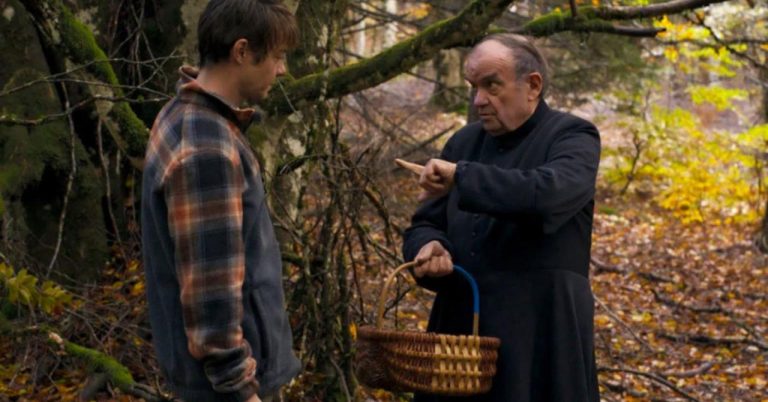
After visiting the film by Serial-Killer (L’Eprie Cruel in 2017), Eric Cherrière, also the author of Polars, part in the Middle Ages: sword, bure dress and right of cooking. It starts in the wolf pact with John Woo fights to continue in a more sententious tone in interiors in wood fire. We see the late Edith Scob in what will remain his ultimate role, Pascal Greggory plays aging lords and the magnetic Saleh Bakri surely wonders what he does there. In which film are we exactly?
Thomas Baurez
And also
In the shadow of Marlow, Aurélien Harzoune and Bertrand minor
Ordinary and extraordinary stories, by Laurent Firode
Nenuphar, by Julien Botzanowski
Terminal, Shudi and Yann Cornières
The covers
Between heaven and hell, from Akira Kurosawa
Palombella Rossa, from Nanni Moretti
The Party, by Blake Edwards