
Ricky Gervais puts on a show in Annecy with stray cats and a lot of bad words
With his series Alley Cats, Ricky Gervais tackles animation and injects his fascination with the cruelty of everyday life, damaged characters and emotion. Presented in Annecy by Netflix, the first two episodes are frankly hilarious.
There were cats, laughter, a birthday (Ricky Gervais’) wished in unison by an entire room and, obviously, an unreasonable amount of swearing. In Annecy, Ricky Gervais came to defend Alley Cats, his new animated series for Netflix, during an exchange led by our colleague Perrine Quennesson. Even before the lights went out, the tone was set: “I hope you like cats.” And the bad words. »
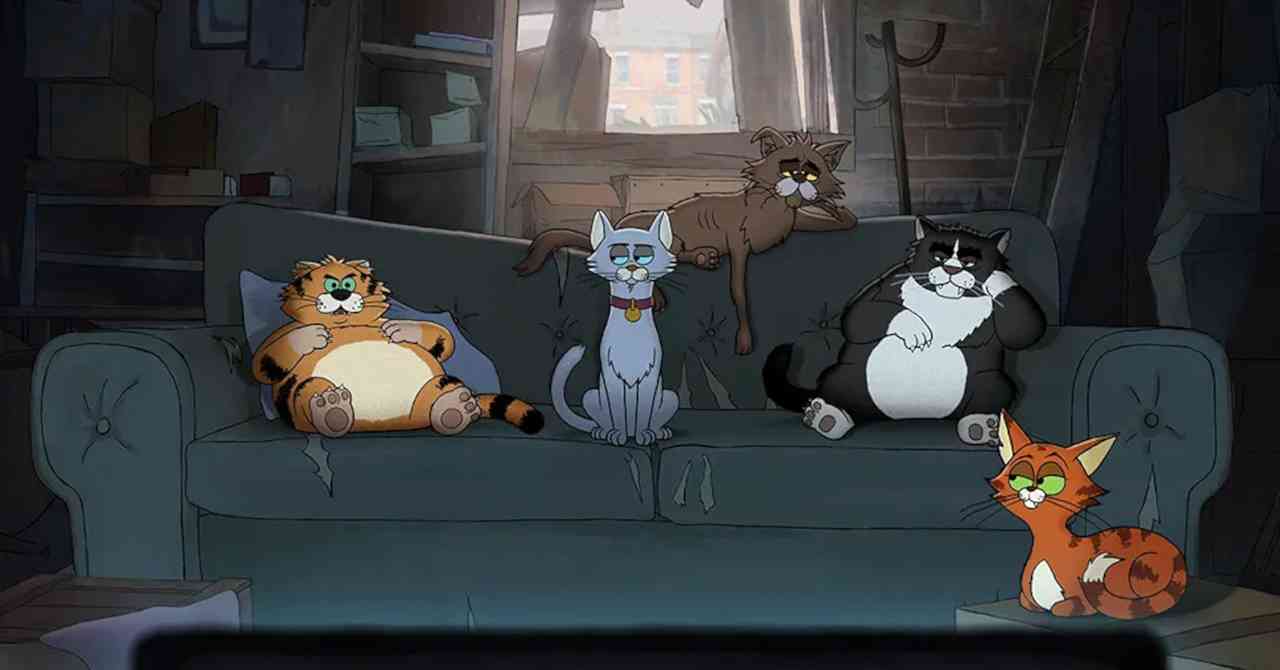
We were able to discover the first two episodes of this animated comedy, dedicated to British stray cats. The comic mechanics work immediately, supported by writing that lets the characters throw barbs at each other and drift into conversations that are as banal as they are absurd. Gervais does not see in Alley Cats a break with his previous work, the creator of The Office and After Life having simply shifted his playing field. Where until now his heroes were more or less pathetic humans, often convinced of being more brilliant than they are, here are now felines who “think they are lions”.
But why animation? “For many reasons. I don’t have to go through hair and makeup or get up early. I can just sit in a chair and do that forever,” he explains. Alley Cats is not, in his eyes, an animal fable or a manifesto labeled “adult animation. “It’s a sitcom,” quite simply. “I don’t even like the term ‘adult animation’ because it’s a cat family, like a sitcom. The recording is very different from the usual animation: we were all in the same room, sending each other lines. »
This way of working partly explains the energy of the series. Gervais speaks of a real play space rather than a locked mechanism: “We write, then we play with what we have written. It’s a lot of fun. There are no restrictions. » He also admits that he was sometimes surprised by the freedom the team had. “There were times when I said to myself: “Can we really do this?!” » The answer, obviously, is yes.
Obviously, vulgarity finds its place in Alley Cats (it’s a series by Ricky Gervais!) and arises from a gap between the banality of the situations and the sometimes very direct violence of the words used. The author gave a simple instruction to his actors: “Don’t try to be funny.” Everything is realistic, apart from the fact that the cats talk. Think of them as people sitting on a couch, watching TV. A sitcom is all about the characters. If you like them, you can watch them do nothing. I could watch Homer Simpson reading something for hours. I told everyone, “If people like these cats, then we will have succeeded.” »
The ambition might seem modest but Gervais above all seeks to get the public to become attached to beings who, seen from afar, have nothing heroic about them. Even their stupidities become material in their own right. “Just the fact that someone is animating this absolute nonsense is already funny. »
Animation also imposed a new working method on him. He says he had to learn quickly, while maintaining the tone that made him famous. “Damn, I don’t know how we managed to do that.” The result was not only exactly as I imagined it in my head, but it even seemed… easy. It was fun! There’s one thing that we did three times: There’s a dance at the end, and we had to figure out the best way for these cats to dance. »
Behind the laughter, Alley Cats does not renounce emotion. Gervais discusses the use of The Smiths’ There Is a Light That Never Goes Out in one of the scenes, and its relationship to emotions in fiction. “This song is both so existential and so uplifting. Everything I’ve done is slightly existential, and that’s heightened with cats, because they have such short lives. Then we had to get permission, so I had to write a nice letter to Morrissey. »
Death, in fact, is deliberately present in the series (it already held a huge place in After Life). “I like pathos. In all fiction, we create our own heroes and our own villains, like a role-playing game for our soul. I was never interested in saying, “Oh, what a beautiful tracking shot.” Do I believe the actor? Do these characters matter to me? In everything you do, there must be a bigger picture. Otherwise, people don’t care. I want the audience to want them to survive. »
For now, Netflix seems to have embraced the idea with a certain pragmatism, as Gervais explains, not without slipping in a very clear appeal in favor of a sequel: “I also have to say how great Netflix is, because I want a second season. They ordered the series based on this: “There are cats and they swear a lot.” “And what’s going on?” “Nothing is happening.” »And to specify that he has “always written about humanity. I like to be honest about it. Drama hides the faults of a hero; comedy exaggerates them. She says: “We are all idiots.” I love humanity and I love bringing that out. »
Alley Cats, August 7 on Netflix.


