
(Cannes 2026) With Sanguine the burn-out turns to gore
When there’s luck, there’s fun! Marion’s first feature The Corroller takes Mara Taquin to an emergency room where burnout begins to bleed hard.
This is not a discovery: female body horror is no longer transgressive, it has even become institutionalized. Presence in Cannes, prices in shambles… Since then Severe, Titanium, Revenge, The Substancethe subgenre has created a grammar, a pantheon, and even a critical horizon. Each film must therefore be a manifesto. We know the codes by heart: the flesh that sheds, the skin that cracks, the organ that speaks. It is therefore into this saturated landscape that Marion’s first feature The Corroller arrives, presented in a midnight screening a few days ago. And the first thing that strikes you (the first good news we should say) is that it does not take itself for a manifesto.
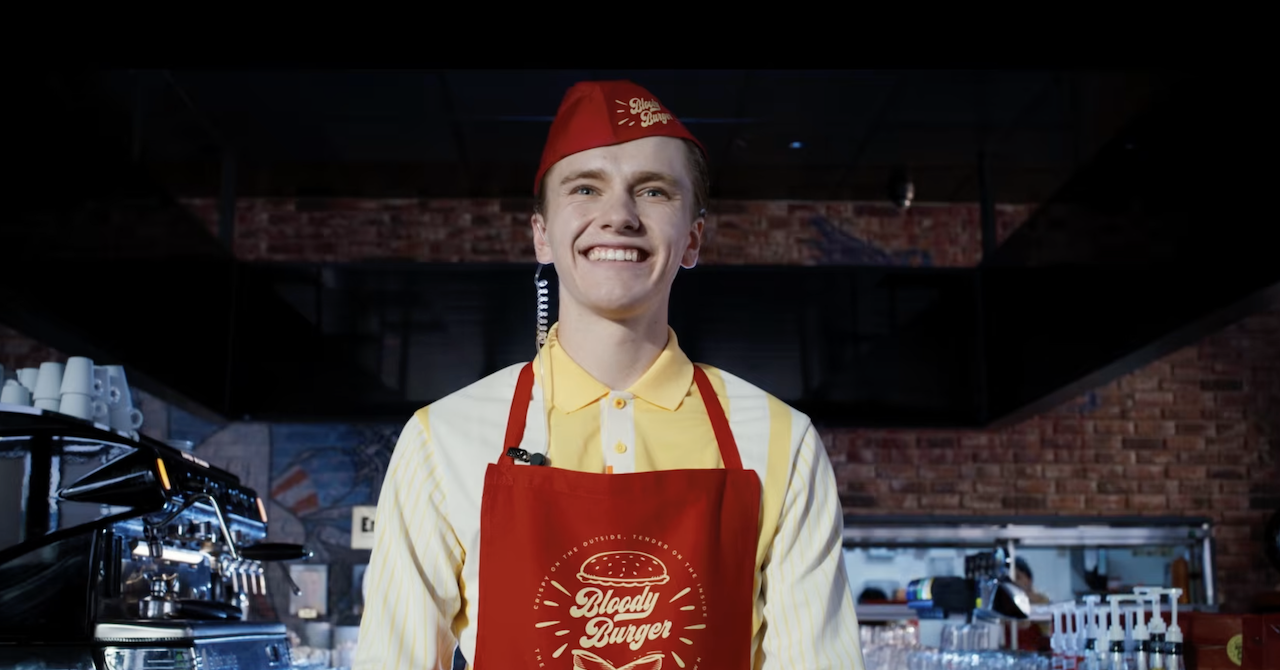
Margot (Mara Taquin) begins her internship in the emergency room. She’s struggling to keep up. Very quickly, she saw patients her age passing by, struck by unexplained symptoms. And soon it was on her own body that she observed the manifestations. The first good idea of the film is there: mutation as a metaphor for the burnout of an over-exploited generation. So there is the young heroine, the physical metamorphosis, the desire and disgust in a closed circuit, the camera which lingers on what is oozing. Despite all this, the film refuses emphasis. No shocking picture calibrated for buzz, no pivotal scene designed like a GIF. Corroller’s film prefers a more refined horror, streaked with self-deprecation, which owes as much to black comedy (hello, the first Sam Raimi) as to satire (hello Verhoeven) or to the cinema of the flesh (hello Cronenberg). The very funny opening sequence in a fast food restaurant Bloody Burgerthe final meltdown filmed in POV or steadycam as close as possible to the faces prove it: this filmmaker has a taste for the bizarre, a sense of decor and a way of playing with the cliché which are better than any declaration.
The question his film asks, ultimately, is what can a body horror film still say afterward? The Substance ? Difficult to go further in the frontal metaphor. Sanguine seems to take note of this impasse and therefore chooses another path: that of a generational product rather than a feminist-theoretical one. The body is no longer the scene of revenge or of an existential metamorphosis, it is a interface – something that we constantly negotiate, with ourselves, with others, with the employer. The heroines of Ducournau and Fargeat were at war. Margot is in management. It’s less flamboyant, but it’s also perhaps more accurate.
This is one of the criticisms that could be made of the film. To be a little wise. His statement on alienation at work comes in the literal sense, and the directing gesture, as careful as it is, never completely lets the horse go: we would like the B series to embrace its madness more frankly. Sanguine is not the film that reinvents the genre. It doesn’t matter. Especially since, more modestly, Corroller shows what the genre becomes precisely when it accepts to no longer be an event.