
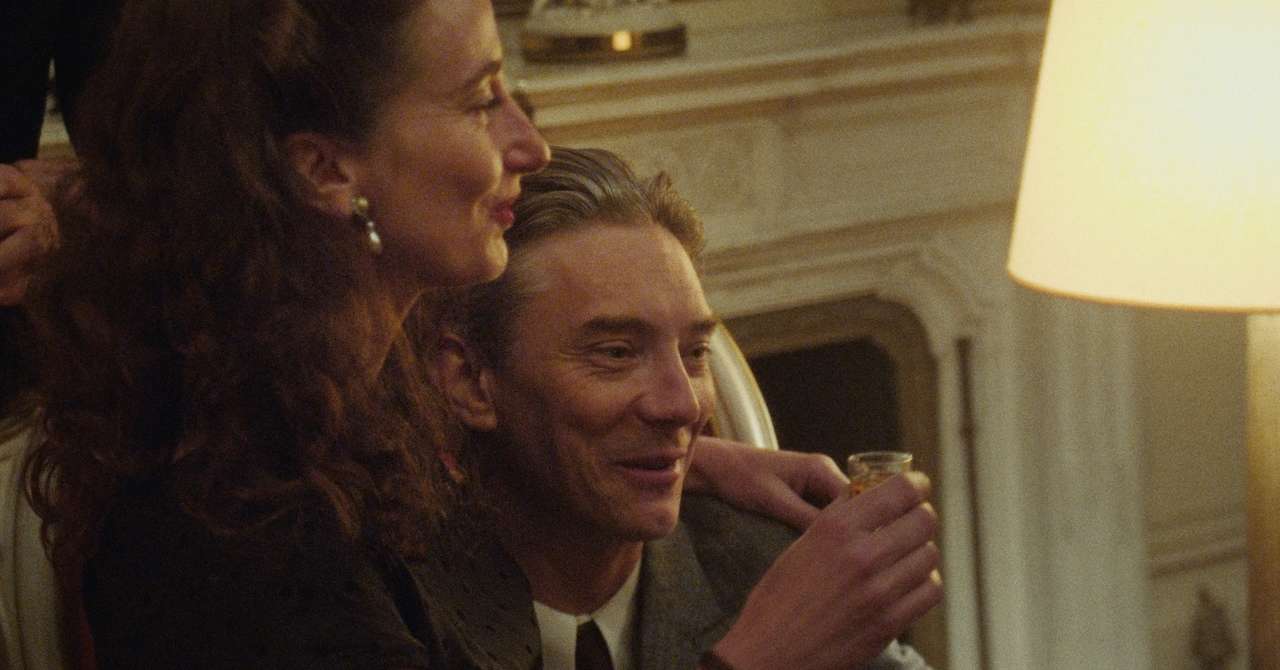
Our salvation seen by Swann Arlaud and Sandrine Blancke
They are husband and wife under the direction of Emmanuel Marre in this chronicle of an ordinary collaborator under Vichy, inspired by the story of his great grandparents. And for Première they returned to the director’s unique working method.
Our salvation takes us back to September 1940, at the time when the Pétain regime was being established. Henri Marre arrives in Vichy penniless, without contact and sees in the new administration the opportunity to finally find the place he considers he deserves, while his relationship begins to struggle. Inspired by the story of his great-grandparents, Emmanuel Marre tells here the chronicle of ordinary collaboration through the prism of a couple living these disastrous years in the antipodes. The more Henri becomes blind, the more his wife Paulette gains clairvoyance. For his first solo feature, the co-director of Nothing to give a damn (discovered at Cannes Critics’ Week in 2021) interweaves French history and the story of a couple falling apart. Swann Arlaud and Sandrine Blancke (“born” in Cannes in 1990 with Toto the heroCaméra d’Or that year) – who play the main roles – return for Première to their arrival on the film and the unique working method of their director.
Swann, Emmanuel Marre says that you started by refusing this role of Henri. It’s true ?
Swann Arlaud: In fact, it’s a somewhat recurring thing for me: I regularly start by refusing the films that I accept! (laughs) In the case of Our salvationthis initial refusal of obstacles comes from a feeling of not being good enough. Because Emmanuel, from a family of polytechnicians, is a brain. And I don’t have these tools. Until he explained to me that Henri was a guy who wore a suit too big for him. That spoke to me because that was exactly how I felt about this project. From there, part of my reluctance disappeared.
But not all?
SA: No because although his script was extraordinary, I really always thought that I was not the character. Emmanuel suggested I try anyway. And we did a first day of testing, according to his method, with improvisations based on answers to a kind of little questionnaire. He put together this audition, sent me the edit. And he agreed like me… that it wasn’t good, that it didn’t work! But Emmanuel didn’t give up and we had a second day of tests then a third after which he entrusted me with the role. However, to be honest, it wasn’t until the second half of the filming that I started to understand Henri. I went to tell Emmanuel. And you know what he answered me? “Beware! » (laughs) All this to explain to you that there was never any question of mastery in this composition. There are so many things that we shot that are not in the film in the end that the Henri that I compose also exists through everything that is hollow, through everything that you don’t see
You mentioned a two-part shoot. How did Emmanuel Marre cut it?
SA: Emmanuel is unique and fascinating in that he constructs the film while making it. That’s even the initial deal: he immediately explained to us that after the first part of filming, he was going to edit the images and that only then could he explain to us what we would shoot in the second part. That he had no idea beforehand. That it was during editing that he hoped to discover the film and its shortcomings. In this case a little intimacy in the couple that I form with Sandrine. And we shot many scenes in this direction…not all of which, again, are in the film!
Sandrine Blancke: With Emmanuel, we have known each other for years. But like Swann, I went through the audition process again. And the very first one was really quite spectacular. We stayed together for five hours and when we left this work session, I told myself that if it ended there, it didn’t matter because he had already given me one of the greatest gifts I had received since the start of my acting career. Because, as Swann says, Emmanuel really has his own way of drawing you into the character.
And when he told you it was you, how did you build this Paulette?
SB: Firstly by relying on his epistolary exchanges with Henri. I did not have access to all of the letters that Emmanuel’s great-grandparents exchanged and that he one day found by chance. Just the five or six that you hear me read in the film. They constituted my basis for finding the inner source of Paulette’s thoughts which then developed during the filming of the written or improvised scenes. I kept coming back to it because I felt like I had something. Paulette is not necessarily a nice person. She is a woman who expects a lot from her husband and can be quite ironic. This is also where we started improv with Swann. Our first contact between actress and actor therefore took place in scenes that were not very flattering. I even had the impression of having gone a little far in this scathing side and that Swann had to tell himself that he was not dealing with the most affable and sympathetic of partners (laughs) And then, in fact, in the second part of filming, we worked on the tenderness which exists deeply between Paulette and Henri even if it can no longer really be expressed.
SA: Yes, this love remains there, despite everything. And this relationship deeply defines who Henri is. A man married to this woman much more intelligent than him and who tells himself that he must have an important place in Vichy France to deserve her love. Which is a pure mental construction because Paulette never asks him. But everything I’m telling you here, I wasn’t spontaneously aware of it when I was watching it. It also came from a work process where Emmanuel relies a lot on what he feels when he arrives on set each morning and can take us completely elsewhere compared to what was planned.
SB: He waits for his actors to take position in space to know what he is going to shoot. I went to ask him one day if he expected anything special from us. And he said, “No, I’m just waiting for something to happen.” » This sentence perfectly sums up what we experienced on this set.
By Emmanuel Marre. With Swann Arlaud, Sandrine Blancke, Mathieu Perotto…Duration: 2h25. Released September 30, 2026


