Why we bow before His Majesty of the flies, not to be missed on Canal+
Between political fable, initiatory story and psychological thriller, this new adaptation reminds us to what extent William Golding’s novel remains one of the most relevant texts ever written on human nature.
More than 70 years after its publication, the novel His Majesty of the Flies still rings true.
In 1954, at the end of the Second World War, William Golding wanted to question democracy, living together, what it means to be a society in the world after. Oppose the collective to individualism. Power to humanity. And to support his demonstration, the writer imagined an experience as simple as it was formidable: abandoning children on a desert island and observing what happens when menstruation disappears.
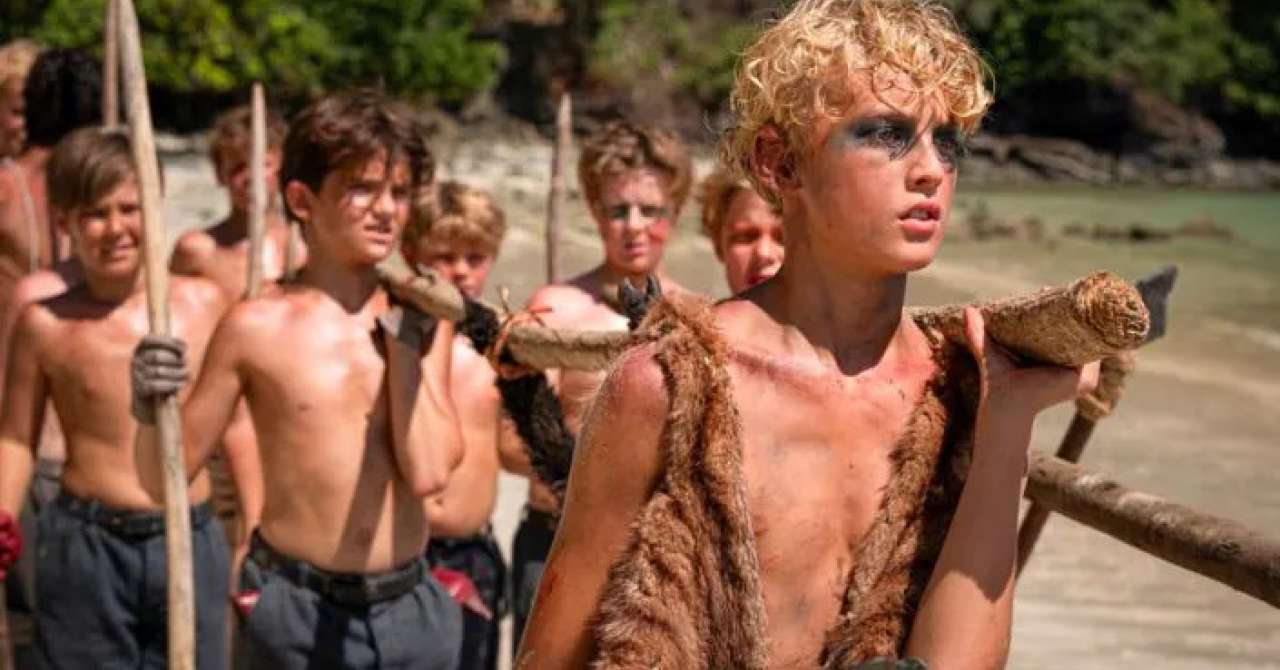
In this initiatory story if ever there was one, and which has inspired so many modern works (Lost, Battle Royale, Yellowjackets or even Koh-Lanta) young British people flee a destructive war (which we guess is the Second World War). Sent away from the chaos by their families, they find themselves left to fend for themselves when their plane crashes in the middle of the ocean. The adults responsible for supervising them all died in the accident. Without any supervision, they now have complete freedom to shape their new environment. Initially influenced by their education, these little Englishmen will recreate a society almost naturally. Elect a leader. Build a form of democracy where everyone has their place and their role. But quickly, the tensions linked to survival bring to the surface the most primal instincts, individualisms and natural authority figures. In their daily struggle to survive, consumed by permanent fear, will our Robinson Crusoe in short pants be able to resist the sirens of the charismatic leader ready to overthrow everything to seize power?
Any resemblance to our current society is obviously not accidental. William Golding’s novel retains a stunning relevance, further reinforced by the pen of the brilliant Jack Thorne. The screenwriter of Adolescence and Harry Potter and the Cursed Child knows how to perfectly capture the torments of childhood, this fragile moment when we begin to choose the adult we wish to become. The post-apocalyptic context of the desert island allows these questions to be exacerbated. Thorne fully captures the tension and darkness of the original text. Very quickly, survival turns into a power struggle and childhood becomes the brutal mirror of a humanity without safeguards.
Broadcast across the Channel on the BBC at the start of the year and offered today on Canal+, the series perfectly supports what Golding was getting at: what really makes civilization?
Over the course of four episodes, we discover four different points of view and the children go far beyond the stage of simple symbolic figures. They exist, breathe and impose a real emotional presence. The staging, often poetic and stylized, further accentuates this impression. The series notably makes Piggy its unexpected hero while the young David McKenna, completely unknown until now, delivers a breathtaking performance. Thanks to him, Piggy becomes the moral heart of the story. And opposite him, Lox Pratt, future Draco Malfoy from the Harry Potter series, already reveals an obvious talent for embodying the little punches, the slapping heads and the playground bullies that we love to hate. More broadly, the entire young cast amazes with its accuracy and maturity.
Despite variations, the series remains generally faithful to Golding’s work. The modifications introduced by Jack Thorne enrich the original material more than they betray it. The whole thing is dark, atmospheric, sometimes even almost horrifying in the way it films the children’s gradual drift. Visually, the series impresses with its evocative power and its ability to transform a paradise island into a veritable theater of anguish.
Where Golding still left room for a certain ambiguity between good and evil, this adaptation sometimes seems to defend a more radical idea: that of a humanity programmed to shift when innocence is abandoned. A tense, intelligent and often disturbing rereading, which proves that this classic continues to speak very loudly in our time.
His Majesty of the Flies, in 4 episodes, to watch on Canal + and MyCanal in France.