Annecy 2026: with Rogue Trooper, Duncan Jones creates an astonishing sci-fi war film
Forty-five years after his appearance in the magazine 2000 AD, Gibbons’ blue soldier finally has the right to his film. Duncan Jones makes a sumptuous, funny and venerating comeback.
There was a big atmosphere last night in the Bonlieu room (the heart of the festival). And not just because a photographer burst onto the stage to ask all the festival-goers to launch their paper planes at the same time in order to take a historic photo! No, if the atmosphere was warmer than a Parisian heatwave evening, it was because we were presenting Rogue Trooper. Basically we know Dave Gibbons for Watchmen. But this forgets that before the sacred boxes that he co-imagined with Alan Moore, the British designer had, in 1981, given shape to another monument of local pop culture: Rogue Trooper. This story was launched in the magazine 2000 AD, the punk counterpart of British comics which would welcome Judge Dredd, Slaine and Halo Jones into its pages.
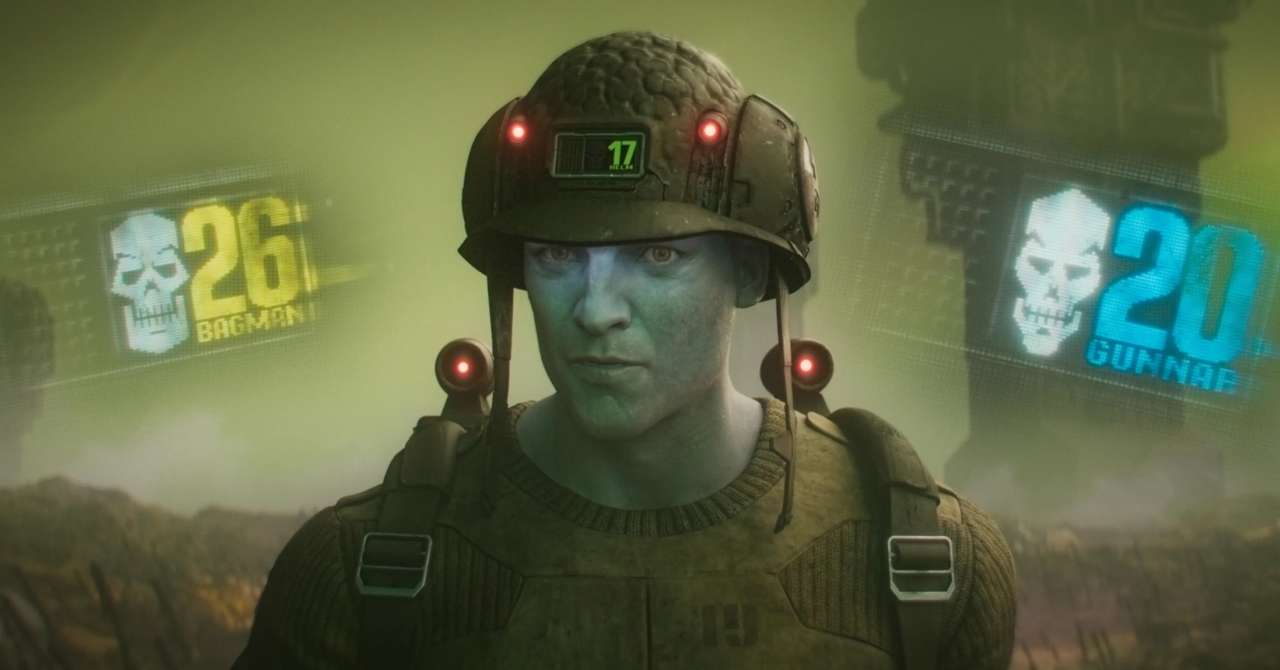
The story of Rogue Trooper takes place in the future, on Nu-Earth, a planet with an unbreathable atmosphere on which two blocs have clashed for generations – the Sudiens and the Norts. GIs (“Genetic Infantrymen”) are blue-skinned super-soldiers, genetically immune to all toxins. The film opens when an entire regiment is massacred, presumably sold by a traitor; the only survivor, Rogue, will hunt down his enemy with, on his equipment, biochips (chips where the personalities of his three dead comrades are stored). So there is Gunnar (stored on his rifle), Bagman (on his backpack) and Helm (the helmet) who interact with Rogue, advise him or… make fun of him. Gibbons’ comic strip was violently anti-Thatcherite, satirical and anti-militarist. And forty-five years later, Duncan Jones is literally at it. He probably had to be Bowie’s son, brought back from the abyss Warcraft and income from Moon to meet the challenge.
Presented with great fanfare yesterday, the film initially surprises with its animation. It took four years of virtuoso tinkering, a hybrid pipeline (Unreal 5.3 engine for rendering and Maya for animation) and a British indie budget to release this hybrid project which is unlike anything known. Very photo-realistic but at the same time hyper stylized, the film is halfway between A Scanner Darkly of Linklater, the Beowulf by Zemeckis, Final Fantasy: The Spirits Within and cutscenes like The Matrix Awakens. In short, indefinable.
If Rogue Trooper uses mo-cap to render faces, the project was done without generative AI (which Jones and his producer Stuart Fenegan reminded an enthusiastic audience yesterday). And its casting perfectly embraces the libertarian and punk vibe: Aneurin Barnard lends the hero a righteous fragility, while Matt Berry and Jemaine Clement give the backpack and helmet a very Monty-Pythonesque flavor. Because it’s not just the graphics that are hybrid, it’s also the overall result. In the film’s best moments, Jones achieves art-house sci-fi that mixes deadpan humor, machine-man melancholy, and venomous satire. Loyalty to 2000 AD is total. It’s therefore trashy, anti-war (and anti-system), lyrical when necessary (the blue or red landscapes of Nu-Earth sometimes look towards The Wild Planet by Laloux), and funny as soon as an object opens its mouth.
There remains the problem of length and therefore breath. Two hours and five is a long time. And the mechanics end up slipping. The motif loops – Snape tracks down the traitor, encounters Norts, dodges a trap or assault, and leaves again. The last third, despite some visions probably borrowed from the original panels, struggles to revive the emotion. We come out a little stunned (and not just from the heat or the explosions). But it would be unfair to ignore this return to grace. Rogue Trooper is an acknowledged cinematic object, which opens with an absolutely sumptuous credits, which pays homage to a little-known classic and proves that there still exists, in animation, a middle path far from the majors and AI.