
Camembert: “The board game film could be a genre in itself”
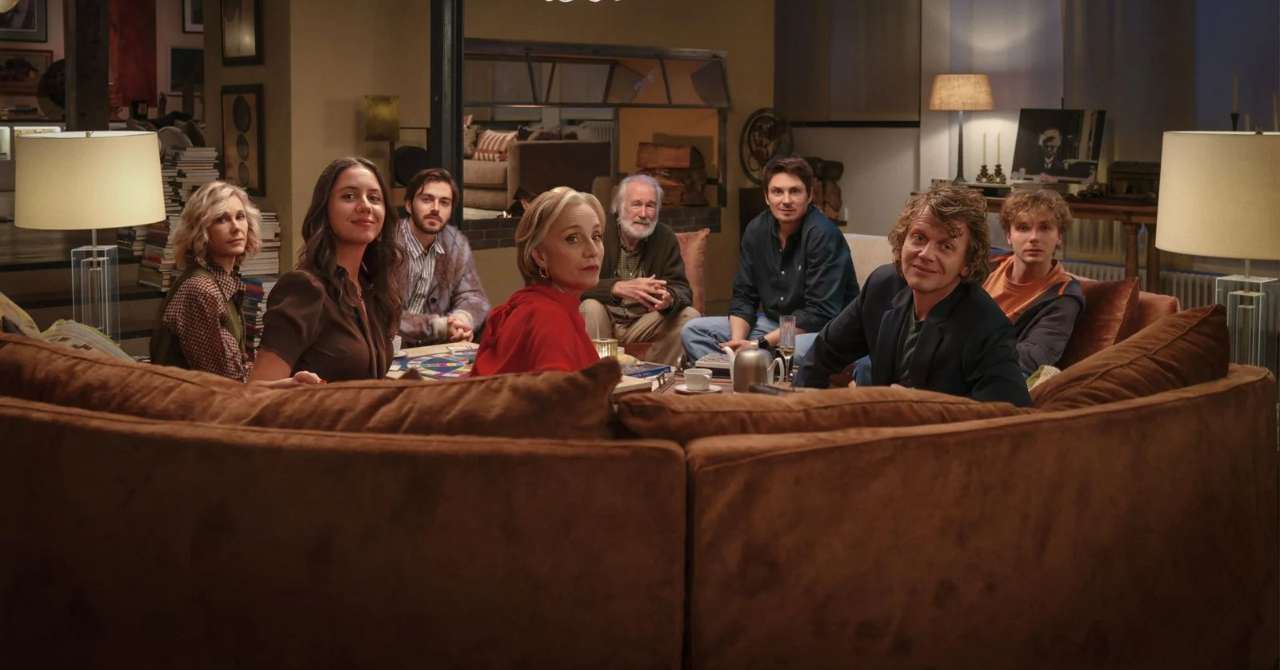
At the Angoulême festival we met Matthieu Rumani and Nicolas Slomka, the duo behind Camembert, a scathing choral comedy based around Trivial Pursuit which should be one of the hits of the fall.
Anyone who has ever played Trivial Pursuit knows what moments of humiliation and anguish each party can generate depending on the questions on which we are dismissive and which reveal an ignorance that we all try to hide.
The duo Matthieu Rumani-Nicolas Slomka, to whom we owe the series Worshiphad the good idea to make it the driving force of their first feature film and to use a part in real time to dynamite from the inside a family with already apparent flaws.
With this idea of culture as a mode of social recognition and therefore by extension of integration or exclusion depending on one’s level of erudition. And a delightful cast: Kristin Scott-Thomas, Alex Lutz, Pascale Arbillot, Bernard Le Coq, Panayotis Pascot, Anaïde Rozam, Guillermo Guiz and Jérémy Gillet. The enthusiastic reception received at the Angoulême festival bodes well for a successful career in theaters…
How was the idea of Camembert ?
Nicolas Slomka: It all started from an article that we read in The Worldwhich recounted the Trivial Pursuit evenings at Sciences Po from the point of view of scholarship students who felt obliged to revise the cards and questions to avoid having a humiliating evening. We immediately saw a fascinating subject but without knowing if we would be able to hold the concept of an entire film around a part of Trivial Pursuit.
Matthieu Rumani: We also check that no one has ever made a film of it. And we are surprised to discover that this has never been the case. Because, basically, it’s like those trial films where, at one moment, there is an arena, an issue. The board game movie could be a genre in itself!
NS: And then the writing challenge comes very quickly; can we last 90 minutes around this game board?
MR: We had to find restarts, have a moment where our characters will abandon the game and then get back into it
NS: And we are fans of films that have this type of device. We love The idiots’ dinneror the cinema of Jaoui-Bacri. These are huge references. We worked for five years. 27 versions in all! We assumed the theatricality because it is really part of this type of comedy. We did not try to get out of it artificially.
MR: On the other hand, on the staging side, there was real reflection very early on with the cinematographer Jean-Paul Agostini, the decorator Samantha Gordowski and the costume designer Emmanuelle Youchnovski to develop a universe, with an artistic direction that was truly cinematic. We also wanted to create chaos to find accuracy. So, when people are arguing, the camera will look for the faces as if it were representing one of the characters.
NS: This device also allows a form of freedom in the staging. Every morning, we did a six-page layout. We researched with the actors by watching them play and listening to what they proposed. And, from there, we decided on the camera axes. With this advantage that even if we had packed up everything during the day, we could continue the next day because we remained in the same setting. Constraint became an asset.
MR: For this, we also relied on our editor Alice Plantin, an excellent comedy editor (What did we do to Bond Dieu?, Coexist…) who worked throughout the filming to put things together and who especially told us when, in his eyes, things were missing.
Camembert also relies on the quality and variety of its casting. Did you write with actors in mind?
NS: The only actress for whom we were certain very early on was Anaïde Rozam, because we had done the Culte series with her and we found her fabulous. But we didn’t talk to him about it until we came up with a version of the script that suited us.
MR: From there, quite quickly, Kristin Scott-Thomas seemed obvious to us because there was something a little Anglo-Saxon in the dynamic and in the way of telling this story. And then, we really tried to form a family, a troupe… And it obviously wasn’t easy to bring them all together at the same time on a set, each having commitments on stage. We had to juggle with the unavailability of some people. We didn’t have certain axes of a sequence that we completed the next day with the axis that we were missing because the actor was not available.
And how do you divide the work between the two of you?
disagree, we defend our ideas, we are very invested in what we do.
NS: We’ve been working together, writing and directing, for over 20 years. We started in high school. We made short films, a bit of advertising, clips… And we ended up finding a rule: if one has an idea the other doesn’t believe in, it’s because it’s not yet the right one. And if we have two opposing ideas, it’s because we need a third. From the moment we accepted these principles, we stopped struggling. We always manage to find a better solution. And on set, we both do everything. For example, we don’t decide in advance who is going to talk to whom at the end of the take. Between us, all it takes is a look, a small gesture, a smile, a thumbs up and it happens naturally
MR: We have the same music in mind and that’s the main thing, especially on a film like this. We lead a lot by ear. Besides, Kristin was able to ask us… to sing her lines so that she could assimilate the music we had in mind!
And how exactly did your shared story begin?
MR: It’s an improbable story. It was our parents who introduced us! (laughs) They were doctors and worked in the same clinic. Everyone knew that the others’ son wanted to make films so they wanted us to meet. Except that at that age, adolescence, we don’t want to do what our parents suggest. So they twisted our arm by sending us both to some kind of movie summer camp. And we came back as friends. When we came back, we made a first short film together and we never stopped.
Does writing a film that you direct change anything for you?
NS: We love writing even if it is the phase where there is the most suffering, wandering and despair. While the realization phase is completely enjoyable. This is the moment where everything comes to life, so it’s pure fun.
MR: But if we have worked well enough upstream, we know that even if we are lost during filming, there is a road map. We trust the text right up to the editing. A real mountain because we had 70 hours of rush. And in the end, we barely cut anything. The characters speak so quickly, everything happens so quickly that finally, keeping everything together, we arrive at a film of an hour and a half.
NS: The first editing step was done by Alice Plantin. She was the one who climbed the mountain while we were filming. And our job was to go and review each take to see what the best intonation was for each actor. We reviewed the 70 hours. And 100% of the time, Mathieu and I agreed. Alice was amazed! This film was built, brick by brick.
MR: Camembert by pie! (laughs)
NS: And we ended up getting to the top of the mountain.
Camembert. By Matthieu Rumani and Nicolas Slomka. With Kristin Scott Thomas, Anaïde Rozam, Panayotis Pascot… Duration: 1h31. Released November 18.


