
Supergirl, In waves, They called him Robin Hood: what’s new at the cinema this week
What to see in theaters
THE EVENT
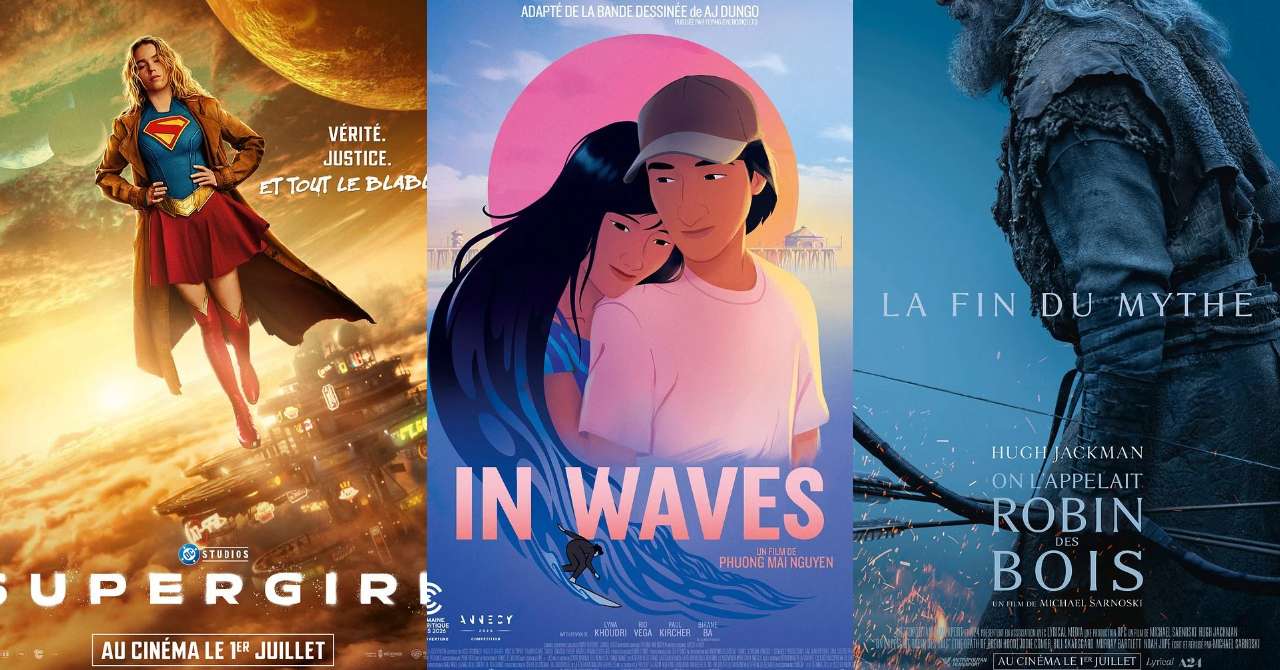
SUPERGIRL ★☆☆☆☆
By Craig Gillespie
The essentials
A year after James Gunn’s Superman, the new DC Universe is already crumbling with the intergalactic adventures of Clark Kent’s cousin: a series of generic scenes in a mochismic space fantasy setting.
Last summer, James Gunn’s Superman marked the cornerstone of a new DC Universe, a promise made with enough enthusiasm that we wanted to believe that Gunn, filmmaker but also boss of DC Studios, knew where he was going. So it’s time for this Supergirl, whose direction was entrusted to Craig Gillespie, a rather adept director when it comes to probing the moods of foul-mouthed anti-heroines, from I, Tonya to Cruella. And this from an excellent comic book, Supergirl: Woman of Tomorrow where the portrait of the superheroine (tortured, in mourning, searching for her place in the universe) was painted through the view of a young extra-terrestrial, Ruthye, encountered during her intergalactic wanderings. The story sticks very closely to that of the comics and, yet, everything that worked on paper completely collapses on screen. A film without idea or creative juice, which will quickly gather dust alongside the previous Supergirl (Jeannot Szwarc, 1984) on the shelf of anecdotal DC movies, not even sufficiently flamboyant in their failure to hope for any sort of cult destiny.
Frédéric Foubert
Read the full review
PREMIERE LIKED A LOT
IN WAVES ★★★★☆
By Phuong Mai Nguyen
For his first feature, Phuong Mai Nguyen adapts the eponymous comic strip by Californian cartoonist AJ Dungo. A very personal story – that of her love story with Kristen and their fight against cancer – which she takes on with virtuosity, describing this tragic romance against a backdrop of skateboarding and surfing with great delicacy. His mastery of animation is as impressive as the virtuosity of his narration, his portrayal of the drawing (In Waves incorporates real creations by the real AJ) and his work with the actors, who have been at the heart of the development of the project since its origins. We see Lyna Khoudri playing under the image, as much as we hear her. We let ourselves be carried away, and we come away amazed and with tears in our eyes from these 90 minutes of pure emotions. Great cinema.
Edward Orozco
Read the full review
FIRST TO LIKE
WE CALLED HIM ROBIN HOOD ★★★☆☆
By Michael Sarnoski
Michael Sarnoski here portrays a Robin Hood who, in the twilight of his life, intends to reestablish the truth: no, he was not a merry bandit in tights who robbed the rich to give to the poor, but a bloodthirsty thug who told stories about him so that gullible guys would follow him “into the darkness”. In this role, Hugh Jackman (who had already superbly played a desperate Wolverine in Logan) turns out to be magnificent as a exhausted brute. We are first struck by the violence of the film, uninhibited, bordering on nag. Before the story makes an astonishing change of regime halfway through, when Robin finds refuge within a religious community, a sort of purgatory where he will meditate on the power of myths and stories through philosophical-bucolic conversations. Michael Sarnoski demonstrates here the same qualities and the same limits as in his Pig with Nicolas Cage as a truffle-hunting hermit: ability to sublimate a star by ridding him of his tics and trappings, desire to torpedo the promises of action and castagne with a very pronounced taste (sometimes too much) for contemplation. Between intellectual stasis and encore pranks, the film remains in any case an original proposition.
Frédéric Foubert
Read the full review
ANDRE IS AN IDIOT ★★★☆☆
By Tony Benna
The idea of spending 90 minutes seeing a man suffering from colon cancer diagnosed too late and dooming him in the short term does not seem very appealing. Multi-award-winning at Sundance, this diary-style documentary towards death immediately shatters all these reluctances. Due to the extraordinary personality of this advertiser capable of facing this ordeal with a mixture of lucidity and humor which aptly accompanies the playful production of Anthony Benna even in his use of animation to translate what is happening in the head of this man who is really not cut from the same wood as everyone else. But the real success of the film lies in its final stretch. When, after having done the show, André splits the armor and prepares his farewells to his loved ones. The film’s ability to never betray the pact made with the viewer – to upset without falling into lachrymal ease – is then a tour de force.
Thierry Cheze
GHOST ELEPHANTS ★★★☆☆
By Werner Herzog
For his twenty-first documentary, Werner Herzog flew to the highlands of Angola to try to unravel the mystery of the ghost elephants of Lisima, probable descendants of the largest land mammal ever recorded. He follows in the footsteps of Doctor Steve Boyes who hopes to see a ten-year-old quest come to fruition and finally get a little closer to these beings as immense as they are elusive. From this “Earth at the end of the world” as the natives call it, Herzog draws a fascinating story which manages to perfectly transcribe the ambivalence of the feelings which grip the South African explorer, divided between the desire to see his long-term work finally succeed but also not to overly deflower the myth that constitutes this little-known species. Herzog also takes the time to paint a portrait of an entire people, paying homage to their habits and customs, avoiding any judgment. We will only regret a few lengths and a voice-over which ends up being a little too omnipresent.
Anne Lenoir
OUR HISTORY-CHRONICLES OF CAIRO ★★★☆☆
By Abu Bakr Shawky
You enter like a mill in this small, noisy apartment in Cairo. This cacophony that can be heard from the street, young Ahmet owes to his parents, his two brothers, and, occasionally, a whole bunch of uncles/friends/neighbors who occupy the sofa during football matches. He, an aspiring pianist, dreams of elsewhere. From Austria, more precisely: where his correspondent, Liz, lives and where classical music reigns supreme. From 1967 until the 1980s, he left, returned and ended up staying with his family. Behind this joyful family fresco, sometimes funny, shines through that of an Egypt in full transformation, crossed by armed conflicts and political transformations. In this ambitious film which never runs out of steam, we sometimes deplore the disheveled pace which prevents us from becoming attached to the ordinary characters of this family, which is quite extraordinary.
Lucie Chiquer
Find these films near you thanks to Première Go
FIRST TO MODERATELY LIKED
MISS MERMAID ★★☆☆☆
By Pauline Brunner and Marion Verlé
Miss Mermaid was first a documentary. The one that Pauline Brunner and Marion Verlé dedicated in 2019 to Alexia, a young maid from Fécamp who, to escape her daily life, had decided to try to become… a professional mermaid by registering for the physically demanding Miss Mermaid competition. A journey to which the transition to fiction unfortunately does not bring any real new dimension. We imagine that by having the opportunity to go further into the intimacy of the character, the two directors hoped to delve even deeper into the questions of identity and emancipation, addressed in the documentary. But, despite the talent of Aloïse Sauvage in the central role, Miss Mermaid loses here above all a good part of what made its strength – its singularity – by becoming a social dramatic comedy like any other, with the air of much seen before and without managing to create additional empathy with its heroine.
Thierry Cheze
ENTRY ★★☆☆☆
By Pedro Cabeleira
This is a portrait of Portuguese youth at its most raw. The one who struggles and gets bogged down in crimes, who knows nothing other than violence and who is given no chance. There’s Laura, whose lazy cousin hangs out with the neighborhood drug dealers, Matreno and Fama. A few streets away, Nadia, mother of a little girl, meets her companion Virgilio, a boss who has just been released from prison. All these beautiful people participate in the plurality of representations, each being totally dispensable. The characters cross paths and cross paths again, sometimes without impact on the narrative. Only the setting – the neighborhood ecosystem – will constitute the anchor point of this choral film (and will not only be used as a backdrop). If we can recognize in it a naturalism freed from the usual apology for delinquency, we regret the lack of cohesion of the whole.
Lucie Chiquer
LEAVE US THE KEYS ★★☆☆☆
By Yacine Helali
In 2021, following the judicial liquidation of a McDonald’s in the Northern Districts of Marseille, Kamel Guemari, the last employee remaining on site, after having considered setting himself on fire for a while as a form of protest, transformed the place into a space of collective solidarity: After Mr. Leave Us the Keys tells from the inside this social experiment which is all the more unprecedented since the pot of earth has for once brought down the pot of iron. This documentary has an undeniable virtue of testimony. But, in 1h30, he struggles to find the right balance between the daily story of the practical organization of this solidarity and the exploration of the tensions – internal and external – which accompanied it. Yacine Helali does not make the latter invisible but would have benefited from giving them more space and digging into them to tell with more relief – and by ricochet force – this fight that on paper everything or almost everything had to lead to the wall.
Thierry Cheze
PREMIERE DID NOT LIKE
A STRAWBERRY FIELD FOR ETERNITY ★☆☆☆☆
By Alain Raoust
The rare year-round residents of Le Temps des Cerises live out their last adventures in this outdated campsite on the edge of a lake destined to be transformed into an ordinary leisure center. Over the loudspeakers, a host shouts for this small group of people left behind as if they are aware of their glory. A small marginal world that lives on mutual aid, trying to maintain its little haven of peace at all costs. As usual, Alain Raoust takes his time between two films, his last feature film (Rêves de jeunesse) having been released in 2019. In his desire to create a bittersweet comedy, he draws a series of portraits of characters, each more iconoclastic than the other, barely distorting mirrors of a fragmented society, shaken by a crisis from which it cannot see the outcome. Unfortunately, he struggles to take us on board with him and ends up tiring rather than really challenging us.
Anne Lenoir
And also
Around Lucio, Etienne Barrier and Pierre-Alain Delisse
My first cinema with the three Bricochons by Romain Villemaine
License to destroy by Eric Fraticelli
The covers
Let’s say, one evening at dinner by Giuseppe Patroni Griffi
Kwaidan by Masaki Kobayashi
Tomb of the Fireflies by Isao Takahata


