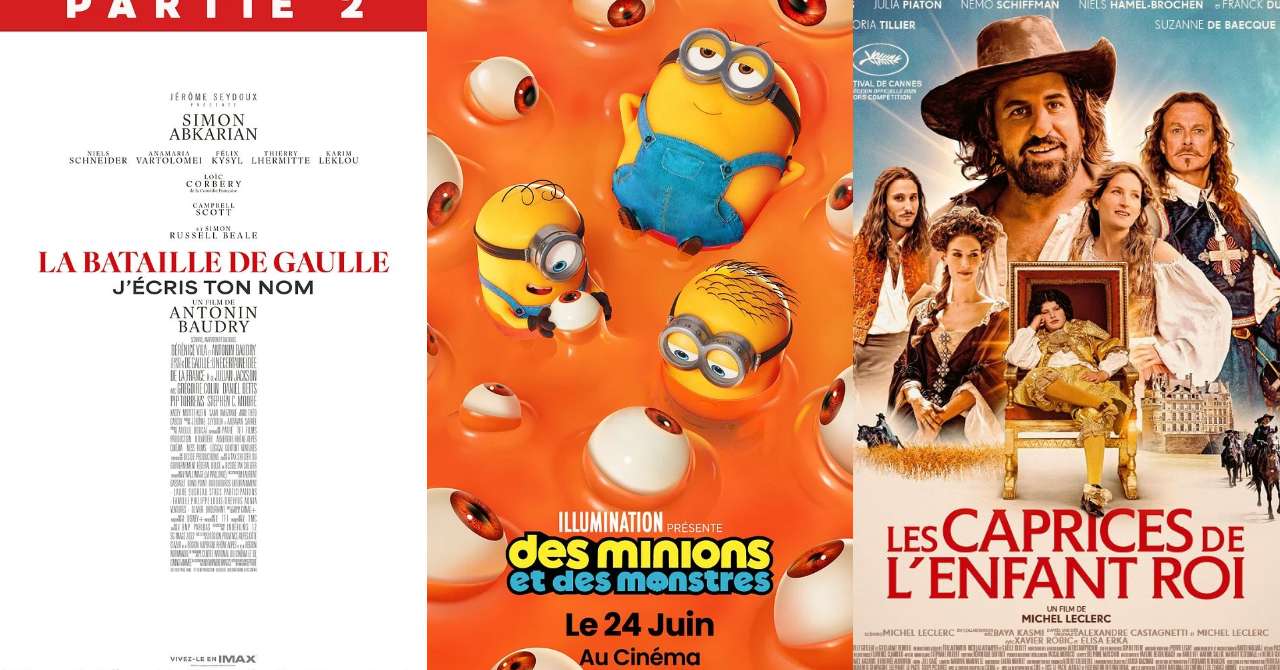
The Battle of Gaulle – part 2: I write your name, Minions and monsters, The Whims of the Child King: what’s new at the cinema this week
What to see in theaters
THE EVENT
THE BATTLE OF GAULLE-PART 2: I WRITE YOUR NAME ★★★★☆
By Antonin Baudry
The essentials
This second part of Antonin Baudry’s diptych displays tremendous dynamism without losing any of its narrative breadth, all to the glory of its imposing hero. Dear spectators, it is time to (re)dive into the Battle.
Here comes de Gaulle again! After The Iron Age, I Write Your Name closes Antonin Baudry’s tough-guy diptych. The present adventure restarts precisely in January 1943 in the Libyan desert where another General, Leclerc, shines on the ground this Free France in which most people no longer seem to believe. And where at the same time in the streets of Lyon, Jean Moulin sought to create a National Council of Resistance which would bring together all the unions and political parties opposed to the Vichy regime. An underground France therefore still stands. That’s it for the battles to be fought on the screen. And behind the camera, Baudry deploys in this second part a stunning dynamic and narrative breadth. Both emphatic and patriotic, this “2” Gaulle inscribes this fight for freedom with the right amount of didacticism and enthusiasm to unite the greatest number, displaying a consistency of tone that the first lacked.
Thomas Baura
Read the full review
PREMIERE LIKED A LOT
MASPALOMAS ★★★★☆
By José Mari Goenaga and Aitor Arregi
Upon retirement, Vicente chose to settle in Maspamolas, a small town in the Canary Islands known as a cruising spot popular with the homosexual community. With a desire to make up for lost time. These long years when this father was unable to come to terms with being gay before cutting ties with his daughter whom he then stopped seeing. At 76, his body continues to exult. Until the day when carelessness suddenly ends after a stroke. Vicente then finds himself placed by his daughter in a rest home from which he will have only one obsession: to escape. Beginning in a raw atmosphere that Alain Guiraudie would not deny, Maspalomas then turns into an intimate melodrama. The Arregi-Goenaga duo shines as much in filming exultant bodies as the harsh face-to-face encounters between a father and a daughter who reproaches him for devastating selfishness. A film as raw as it is delicate which tells of the still poorly extinguished fires of prejudices and taboos continuing to surround homosexuality
Thierry Cheze
Read the full review
EEGA, THE VENGEOUS FLY ★★★★☆
By SS Rajamouli
If the cinema of SS Rajamouli stands out above all for its epic breath (The Legend of Baahubali for example), the discovery of a previous project like Eega, the vengeful fly will help to see how all these films display their themes with masterly seriousness. Eega thus establishes a seriously tragic tone (Nani loves Bindu, but the rich Sudeep murders him) before turning in a second phase towards an equally applied revenge story. And at that point, when the film decides to be funny, it goes all out: Nani is reincarnated as a fly and harasses his killer in every way possible. As spectators, we then witness this revenge from two different scales (human, and from the insect’s point of view), this alternation offering Rajamouli the possibility of doubling his inventiveness, particularly on the visual and comic levels. And to reinvent the genre film, and with it, a certain idea of romanticism.
Nicholas Moreno
Read the full review
FIRST TO LIKE
MINIONS AND MONSTERS ★★★☆☆
By Pierre Coffin
This seventh episode of the Despicable Me franchise sends the yellow capsules to the cradle of US cinema, at the time when Universal was inventing its founding monsters. This film therefore sees the minions become silent stars, directing their own feature films, before talkies put an end to their dream of glory. The process is amusing: it is the Universal house which goes into abyss, summoning its own bestiary of freaks – The Mummy, the strange creature from the black lake – under the fluorescent filter of contemporary animation. The result oscillates between cinephile delirium and proven recipe. Coffin masters his burlesque choreography perfectly, even going so far as to make the Minions the origin of the best silent gags. But as these gags unfold, the “banana fan service” ends up becoming the alpha and omega of the script and the parallel stories feel reheated. The fact remains that for fifteen years, Illumination has been producing pop animated cinema with impeccable graphic quality.
Peter Lunn
Read the full review
THE WHIMPS OF THE CHILD KING ★★★☆☆
By Michel Leclerc
For his first swashbuckling film, Michel Leclerc chose to play “What if?” “. What if, to escape a plot by Mazarin, Anne of Austria had asked D’Artagnan to exfiltrate the very young Louis XIV from the royal palace? What if D’Artagnan had offered to help Cyrano de Bergerac? What if Cyrano had decided to hide him incognito among Molière’s troupe? The director ventures into this Avengers of 17th century figures while remaining faithful to his DNA, this sense of comedy which addresses political or social subjects head-on or indirectly. Les Caprices… certainly does not rise to the level of Married of Year II, which we think a lot about. The fault is a less twirling staging and a very young actor who is a little too academic as a young king. But we never shy away from our pleasure at the finesse of the dialogues, the accuracy of the casting and the relish with which Leclerc celebrates the collective, as in Le Nom des gens or Télégaucho.
Thierry Cheze
THE STRANGER ★★★☆☆
By Gaya Jiji
Born in Damascus, Gaya Jiji was revealed in 2019 with the excellent My Favorite Fabric about a young Syrian woman torn, during the 2011 revolution, between her desire for freedom and the hope of leaving the country thanks to an arranged marriage. The Stranger is in a way its extension since its heroine (Zar Amir, intense) has chosen to clandestinely flee Syria, where her husband is languishing in the regime’s jails, for France. Gaya Jiji recounts her race against time to obtain the right to asylum and the love story that will blossom between her and her lawyer. And this plot twist, which at first glance seems a little confusing, finds its full meaning in the last act which marks the arrival in France of her husband and their son. The Stranger then becomes a reflection on how to rebuild oneself emotionally when you try to forget an anxiety-provoking past and it comes back to you in the face. All while having the intelligence to ask more questions than to provide ready-made answers.
Thierry Cheze
BLUE HERON ★★★☆☆
By Sophy Romvari
First, Blue Heron takes on the appearance of a lovely summer tale. Head to the 90s, into the daily life of a family who moves into a peaceful neighborhood in Vancouver. But a disastrous atmosphere gradually invades the setting. The erratic behavior of Jeremy, the eldest of the siblings, worries his parents and intrigues Sasha, his little sister. Change of times: twenty years have now passed and now she is trying to make sense of the behavior of her now deceased brother. Faced with this way of filming the naive gaze of a child followed by her painful transition to adulthood, we cannot help but note similarities with Aftersun. But what appears to be a simple denouement in Charlotte Wells becomes, in Blue Heron, a sophisticated staging device. Eras collide, memories intertwine, and we plunge headlong into this devastating whirlwind.
Lucie Chiquer
Find these films near you thanks to Première Go
FIRST TO MODERATELY LIKED
ONLY THE REBELS ★★☆☆☆
By Danielle Arbid
The new film by Lebanese Danielle Arbid takes place in Beirut but could not be filmed on location because of the Israeli army’s bombing of the city in its long-term war against Hezbollah. Everything was therefore recreated in the studio and this form with its assumed artificiality (symbolized by a magnificent final shot revealing behind the scenes) constitutes the major asset of a feature film with a unfortunately less convincing storyline. We follow Suzanne (Hiam Abbass), a sixty-year-old widow of Palestinian origin, falling in love with a young black Sudanese man, an undocumented migrant. The writing of their characters and even more so that of the violent reactions of those around Suzanne lacks nuance and finesse. Only the Rebels never stands out from the various films that have dealt with the same theme. No doubt because the desire to convey a message – certainly essential – takes too much precedence over the way of delivering it. We knew the director of Fear of Nothing and Simple Passion sharper and more inspired.
Thierry Cheze
ERUPTION ★★☆☆☆
By Pete Ohs
This film is first and foremost a curiosity. Charli XCX’s first major big screen role. A project born from a chance meeting in a New York bar with director Pete Ohs and an exchange where they laid the foundations of Eruption. The idea of a romantic anti-comedy featuring a young Englishwoman who has come to spend a few days of vacation in Warsaw with her fiancé who is about to ask for her hand and where she meets again a young woman with whom she had an electric love-friendship relationship a few years earlier. The film does not lack charm, nor Charli XCX lacks acting talent. But while its production is built on daily improvisation, Eruption seems paradoxically too manufactured. Too “in the style of” a whole section of Eastern European neo-realist cinema of the 1960s, rich in formal experiments. A source of inspiration from which Eruption never manages to fully free itself in order to make its own unique little music heard.
Thierry Cheze
NOISE ★★☆☆☆
By Kim Soo-jin
A woman, tormented by the disturbing noises she hears day and night in her apartment, disappears overnight. Her sister, who is hard of hearing, moves into this mysterious apartment in order to investigate… Will she manage to transform her handicap into strength? Will unplugging her hearing aid help her better combat those strange noises that seem to drive the whole building into madness? For his first feature film, Kim Soo-jin chose the option of behind-closed-doors suspense, but the stylistic exercise is unfortunately a bit academic. Functional jump scares, social subject on neighborhood problems in South Korea delivered turnkey… Nothing bad here, but nothing very exciting either, despite a gallery of characters (the disgusting neighbor, the cranky owner…) playfully sketched. In the “South Korean scare film between four walls” genre, it is better to rewatch the recent Sleep.
Frédéric Foubert
And also
Anesthasia, by Damien Boyer
My summer with Irene, by Carlo Sironi
11 Denver Street, by Olivier Thouret
The Perfect(s), family scams, by Ludovic Bernard
The covers
New York 1997, by John Carpenter