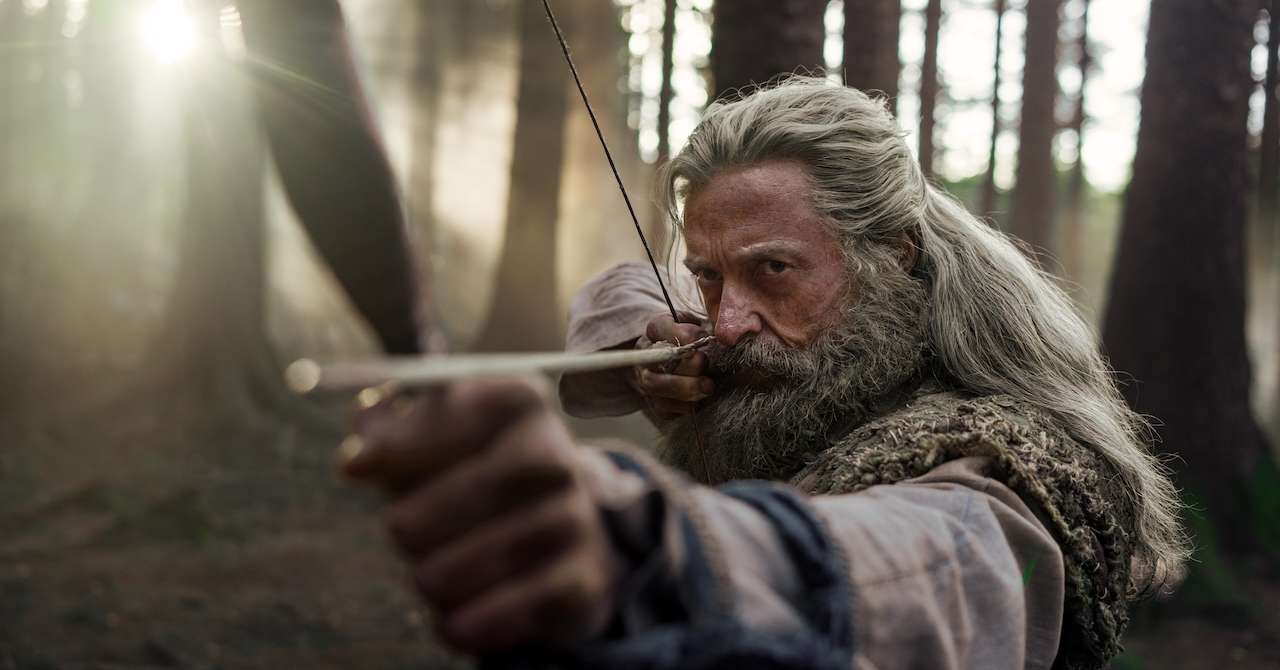
Hugh Jackman: “My Robin Hood reference was Merciless!”
For a long time he played indestructible heroes. In Robin Hood, Hugh Jackman finally plays a mortal man, haunted by his own legend. He confides here about the lies we tell ourselves.
PREMIERE: You have been regularly taking the stage for 30 years to offer the public different versions of yourself: star, Broadway actor, singer, master of ceremonies… While preparing They called him Robin Hooddid you connect this man – the entertainer – to the character?
HUGH JACKMAN: A little, but not completely. What especially interested me was to imagine this Robin in his element: first of all, he is an immense storyteller. A man who understood the power of a story, who is capable of holding a crowd in the palm of his hand. He has his audience, people who follow him and what he gives them, basically, is a form of truth. An arranged truth, but a truth.
The film tells precisely how this man is caught up in the gap between the legends built about him and what he really was. Have you experienced this with the public figure of “Hugh Jackman”?
Surely, yes. A lot of people have a very partial view of who I am – and it depends on what I show them, what they’ve been exposed to. There are whole parts of me that I leave in the shadows and above all that would only speak to very few people. What I’ve always strived for, as an actor, is that the real Hugh Jackman and the roles I play remain two distinct things. Doing a thousand different things, never letting myself be put into a box: “he’s the tough one”, “he’s the singer-dancer”. I refuse being typecast with all my might.
What interested you in this scenario?
That was the concept, and it was mostly Michael (Sarnoski Editor’s note). But when I read the script, I liked this story, this writing. It was beautiful and deeply human. It was going to delve into the gray areas of existence which are the truth of our lives! We spend our time wanting to reduce everything to black and white stories: who we are, what we have done… When everything is complex, and very nuanced. This obviously makes me think of Loganbut pushed even further. And I was talking to you about Michael: I saw Pighis first film. And after ten minutes, I was like, “OK, this guy has a real voice.”
The word that keeps coming up in your interviews, in your films, is: “mythology”.
Because that’s what really interests me: the power of the myth, of the story. Perhaps we all write a mythology about ourselves, whether we’re famous or not. We tell each other stories where, inevitably, we are the good guy. It fascinates me. Robin ends up no longer being able to tell it to himself.
You mentioned Logan. But the difference is that this time, your hero is mortal.
Exactly. And that’s the whole point: living with hatred, pain, illness, regret. The pain of a lifetime. For Robin, it is the very taste of his existence. There may have been a core of happiness in the beginning – the mythology we all know – but it is so far away, almost erased. Today, all he has left is regret.
You have played the most iconic heroes of the last twenty-five years. What attracts you, now, to the journey of a guy who precisely refuses to be one?
The fact that it is true, authentic. This is why I find the film beautiful and human. I had just read a biography of Martin Luther King: the book spoke of humanity, of complexity. We would like a Messiah, a spotless hero. But it is the opposite of humanity. Many things about him were extraordinary, but a man is always more than that. Pain is part of being human. We can try to ignore it, but it is there, everywhere around us. This film sinks into this pain, this violence. We can be a brutal species.
Is this the side you want to explore now?
It had to be there, yes, because it triggered a reaction in my stomach. The edges, the gray areas, the nuances: that’s what interests me. If we want to be honest about who we are, we probably have to be willing to look at what we don’t like. What we would prefer that others never see.
Looking at you, I thought of the last roles of Sean Connery or Eastwood, actors who let the camera record the passage of time. Is this a gesture that you claim?
One of my heroes is Paul Newman. The Verdict…What a film! There are so many moving performances where you feel he has grown as an actor. Think about Shakespeare: most of the greatest male roles are middle-aged roles. It takes time and experience to complete them. So no, I have no desire to stay where I was, nor to try to stay young. None. I want to evolve, continue to push myself, explore what scares me, in life and on stage. And to answer your question, beyond Newman, my reference on Robin Hood was obviously Ruthless !
Were you afraid to play this role?
Not Robin Hood per se. What scared me was understanding that it would take a silent, enormous vulnerability to show the pain, the sweetness, the hope on camera. I was afraid I wouldn’t make it. And then everything came very easily. I was ready. Basically, I was offered this project at the right time.
Sarnoski says he looked for an actor who “understands lies”, because Robin smells imposture in a second. After thirty years in the business, you must be good at that, right: distinguishing fact from fiction?
There, perhaps I will disappoint you. Before becoming an actor, I studied journalism. We had a famous teacher, Wendy Bacon, a woman who had brought down judges, and who didn’t believe anyone. I listened to him, fascinated, because for me, it was the opposite: someone could present me with the worst tyrant, I would say to myself “oh… deep down he seems nice”. I trust, probably too much. Over the years, I may have improved a little. A little. But I’m far from this Robin…
How was your meeting with Michael Sarnoski?
We met in a pub here in New York and started talking. And it was like we were speaking the same language. He felt that I understood. There was immediate trust. He’s a brilliant guy, who doesn’t need to flaunt it. And it’s only his third film… But if our meeting seemed obvious, the filming turned out to be very difficult: almost everything was filmed on real locations, in winter, on the island, with very little light. The material itself was difficult. The end of the film is very meditative, silent and the violence, conversely, is, I think, trying to watch. I’ve never been more exhausted than I was in those fight scenes. Michael likes long shots: he wanted us to feel how brutal and exhausting it was.