Annecy 2026: La Violiniste rereads the history of Singapore through the life of a musician
Ervin Han and ex-Disney Raúl García follow a violinist from Singapore from the 1930s to today. The animation remains wise, but the story carries everything. The powerful ending earned him a five-minute ovation in Annecy.
The Violinist is the first Singaporean animated feature ever selected at Annecy. That’s for the Wikipedia argument. Interesting, but you will still agree that it doesn’t say much about the film. So let’s start with the pitch. Nowadays, a Spanish journalist attends a concert and leaves the room to follow the old soloist. She is a star violinist who has obviously built her legend on mysteries. Through sheer force of will, the critic ends up landing an interview with the diva.
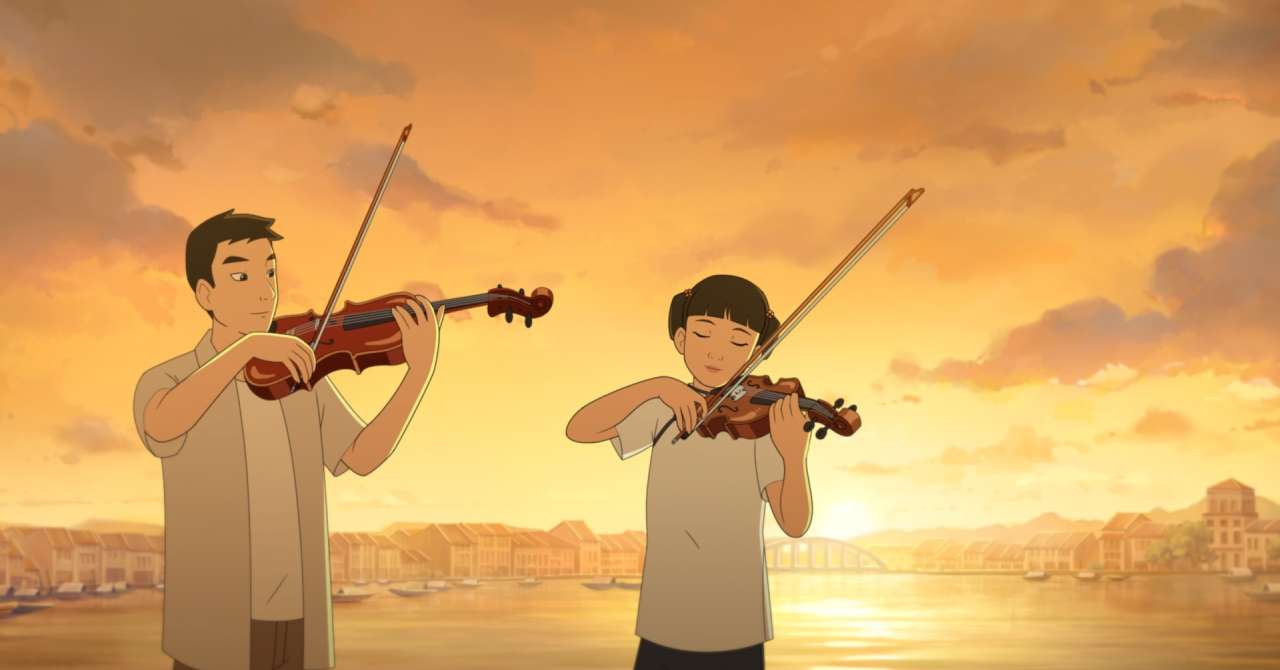
And the story begins: Singapore, 1930s, a little girl (we understand that she is the soloist at the beginning) learns the violin. Her name is Fei. She quickly forms a very strong friendship with a young boy from very poor origins who turns out to be gifted in music. Kai and Fei will grow up together until 1941, when the Japanese arrive. Kai will join the Resistance and disappear. Fei will look for it all his life, bow in hand, on the stages of Asia and the world…
Ervin Han and Raúl García (yes, yes, the former Disney guy, who drew Aladdin, Pocahontas Or The Hunchback of Notre Dame) tell the destiny of these two characters crushed by history. We think a little of Satoshi Kon and his magnificent Millennium Actress – an artist, a country, a century. At the beginning of the story, the journalist asks his questions and the past will tumble forth in waves, the flashbacks overlapping and the violin serving as a common thread. The mechanism is simple, but it keeps you in suspense and allows the viewer to discover this little-known story in our country (the invasion of Asia by Japan).
We also feel that the directors saw Waltz with Bachir Or Persepolis. Since Folman’s classic, animation has started to tell History head-on. With a pencil or a graphic palette, we can delve into the past, bring events to life or imagine past lives sometimes better than live. We therefore discover Singapore under Japanese occupation, the resistance, the bodies falling in the street, the friends we lose one morning without warning: The Violinist tell it straight. The film follows these two kids who History will separate (for half a century) and will never let go of their hands.
One downside though: the animation. Hand drawing, certified without AI (this is the gimmick of this Annecy edition), we will salute the gesture. The rendering is a bit tight. The faces are a little demure, the settings clash with the characters at times and certain movements seem stiff. The coda remains. Nothing will be said about it otherwise the Bonlieu audience stood up and applauded for five minutes at the first presentation.
Singapore therefore enters through the big door on the map of world animation, with a film which firmly believes that drawn images can tell History better than any art.
No release date yet.