Cannes 2026: A few days in Nagi, a delicate sentimental study, at the risk of blandness
Kôji Fukada, for the first time in competition at Cannes, depicts the life of a few lost souls in a Japanese village, with subtlety but also a certain softness.
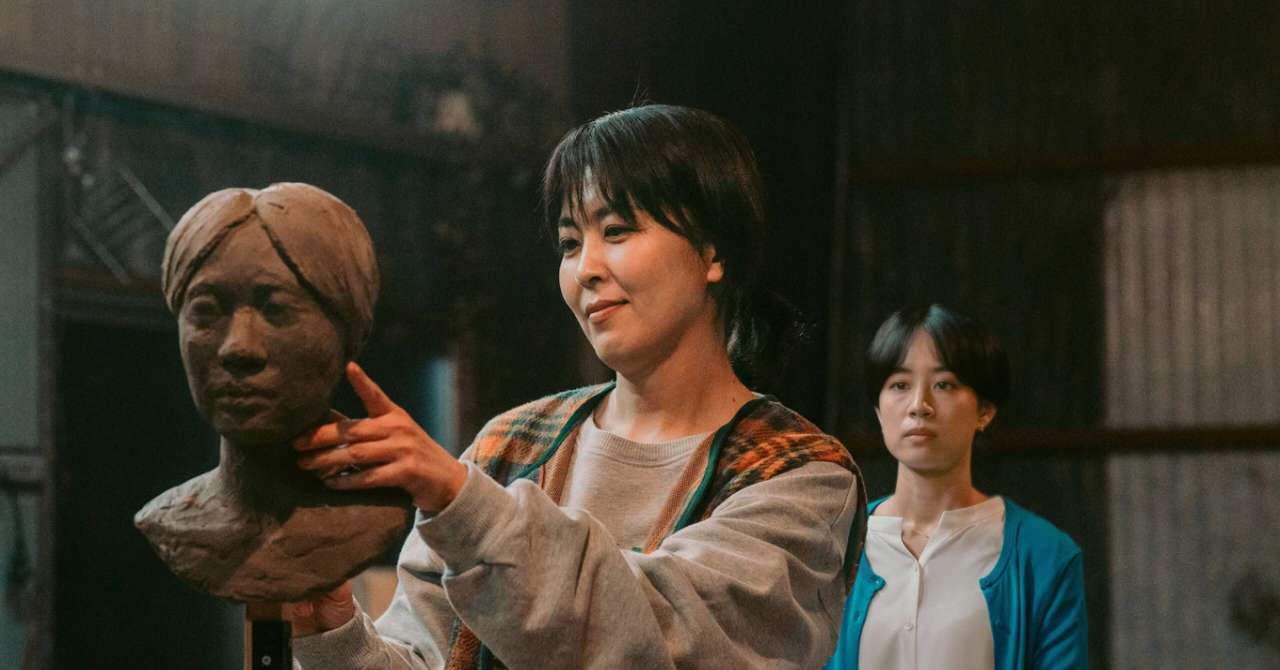
Is the “portrait of a woman” a genre of cinema in its own right? This is the question asked yesterday by the two films responsible for launching the 2026 Cannes competition, A Woman’s Life by Charline Bourgeois-Tacquet and A few days in Nagiby the Japanese Kôji Fukada (Goodbye summer, Harmonium). In the latter, a portrait, it is literally a question, since the film tells of the arrival of a woman architect, Yuri, in the small town of Nagi, in the West of Japan, where she will become for a few days a model for her ex-sister-in-law Yoriko, a sculptor by profession. Yuri’s face will first be drawn, then modeled in clay, before becoming, through strokes with a chisel, one of the wooden busts which will soon fill the artist’s collection.
Kôji Fukada intends here to speak explicitly of the revealing power of art, and to make one feel the efforts and the time necessary to fix in an artistic creation the truth of a being – the entire film, which takes place in the few days which precede the arrival of spring, is punctuated by the recurring shots of the pages of a calendar being torn out. There are things left unsaid between these two women who continue to see each other even though the man who linked them (Yuri’s husband and Yoriko’s brother) has long since disappeared from the picture. Unsaid things that the film will clarify in small touches, through scenes with abundant dialogue but where the truths will still be expressed only lip service, and according to a system of rhymes and echoes between our two heroines and the characters who gravitate around them – in particular two teenage girls who are also art lovers and with confused romantic feelings.
Fukada depicts an endearing little world, and nicely captures the peaceful and timeless air that seems to float in Nagi, between its cow farms, its contemporary art museum, its sporadic appearances of ghosts, and its school festivals where camera obscura artisanal sserve as romantic revealers. Everything here is meticulously drawn, measured, distilled, but the exaggeratedly muffled softness of the tone – which is intended to be a form of politeness hiding the violence of the intimate storms that the characters are going through – ends up bordering on a certain blandness.
We sometimes think of the Kore-eda of Innocence (for the city/country duality, the duo of school friends who question the feelings they have for each other, the taboo of homosexuality in rural Japan) but Fukada, unlike his compatriot, never really manages to break the ice. The town of Nagi is home to a military base, and the film is punctuated, in addition to the calendar, by radio bulletins regularly warning residents to be careful of “live ammunition.” Detonations are heard. But always distant, muted, like this film which does not resonate loudly enough.
A few days in Nagi (Nagi Notes), by Kôji Fukuda, with Shizuka Ishibashi, Takako Matsu… In cinemas October 7, 2026.