Robert Kirkman (The Walking Dead and Invincible): “We must preserve the magic of comics in an adaptation”
Visiting the Annecy International Animated Film Festival to promote the Invincible series, comic book writer and producer Robert Kirkman took a few minutes to chat with Première.
First: We know that you are very keen on creative control of your works, so how do you choose the people to whom you entrust an adaptation like Invincible?
Robert Kirkman: I don’t trust anyone! More seriously, I am looking for collaborators who share some of my sensibilities. With Simon Racioppa, the showrunner of Invincible, we have a fairly close vision of what matters in the series. Our tastes are similar, as is the way we look at the characters and the story. Taste is probably the most important element: what stories do you like? What do you consider essential? In what direction will you guide the project? This is what I try to identify when I am looking for a collaborator.
What was your main requirement for the adaptation of Invincible?
I think too many people approach an adaptation wondering what they could “fix” in the original work. They seek to improve it, or modify it to reach a wider audience. This is particularly true for comic book adaptations. Some people still consider comics as niche things, loved by a small group of readers, and say they need to be transformed, modernized, made more appealing to the general public. This is the wrong approach. We must preserve the magic of comics. For Invincible, we chose an adaptation that is very faithful to the spirit of the original material. The idea was to take what was already working for a passionate audience and open it up to more viewers.
In my eyes, comic book readers are not strange people who should be avoided. On the contrary, they constitute the best possible test audience because they have read the series for years, talked about it, analyzed the characters and the plots… What they have to tell us is a very valuable source of information.
Has the view of Hollywood decision-makers on comics evolved?
Yes, it has improved a lot. Twenty years after the start of this great experiment which consisted of entrusting a significant part of Hollywood to the comic book universe, I think we can safely say that it is working rather well. The economic success of these adaptations has obviously changed things. But there is also more respect for this culture and for the public who have followed it for a long time.
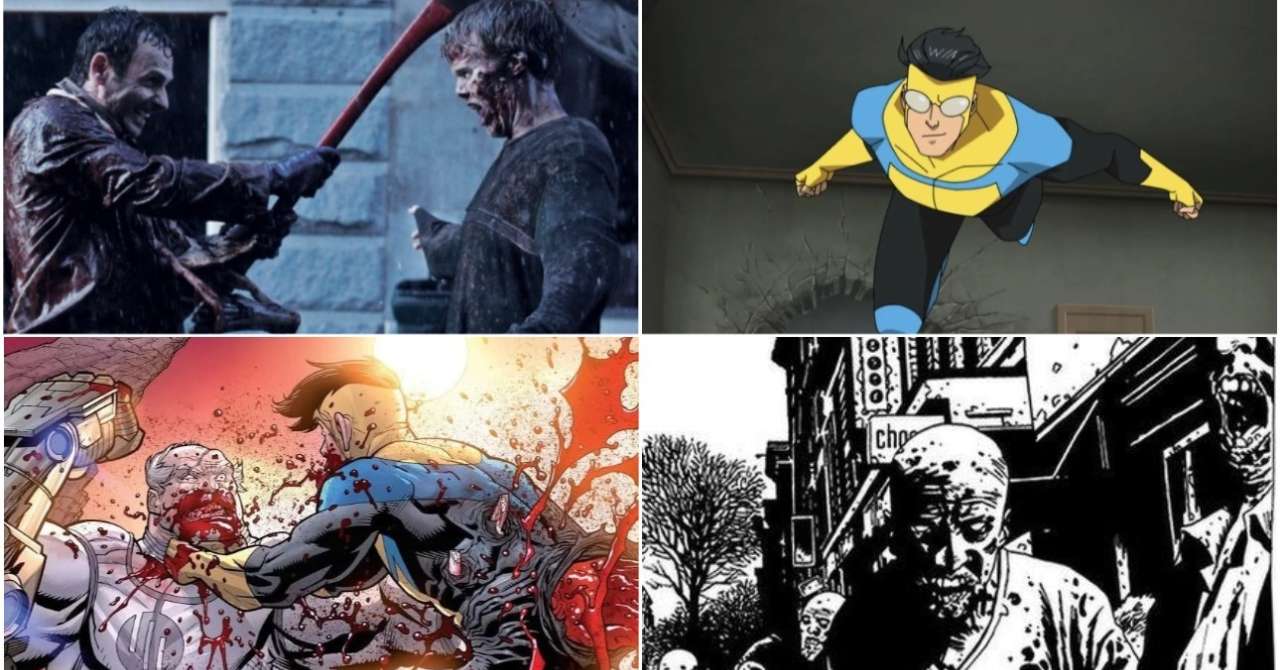
The Invincible series is mainly hand-drawn and has a particular visual identity, straddling something extremely dynamic and still shots that can last a very long time. Some complain about it, others love it…
From a practical point of view, 2D animation makes it easier to manage the scale of the universe. It allows you to introduce more characters and better control the scale of the story. In another form of animation, certain 3D character models would have required much more manufacturing time and a much greater budget, which would necessarily have limited the casting. But there is also an artistic reason, because I deeply love hand-drawn animation. Even if, within our deadlines and with the money we have, we cannot do without a few fixed plans.
That said, the imperfections give something special to the image which allows us to rediscover the spirit of the comic strip. Moreover, Cory Walker, designer and co-creator of Invincible, was artistic director of the first season. And Ryan Ottley (who also drew the comic book) has been executive producer since the start of the series. Cory remains very present: he works with the artistic directors who succeeded him and still intervenes on character designs or particularly complex elements, especially when they must correspond very precisely to the comic strip.
It’s extremely useful. When we’re watching an animatic and I feel like a scene isn’t working visually, they can immediately help me figure out what’s missing, find the right visual language. Their presence makes the series much better.
The violence is very graphic in Invincible and this is its trademark. Is it that…
(He cuts us off) I like that Prime Video gives us this freedom, because these violent scenes are real narrative tools. They make the characters more real, they allow us to feel their fear, their pain, their reaction to the horror. I don’t feel like we’re going too far, because the violence is never just there for show. It is always linked to the characters and the emotion they go through.
Besides, speaking of violence but in another genre, there was an animated series adaptation of your Marvel Zombies…
I didn’t even look at it (Laughs.). Just kidding, kidding. I find the idea interesting, but the adaptation seems to take very few elements from the comics. Everyone will draw the conclusions they want… Maybe it’s better this way, maybe not. I don’t know.
The adaptation of The Walking Dead was very different from Invincible. Already because it was live action, and also because the series has changed a lot over time.
Scott Gimple served as lead showrunner for much of the series. He was a huge fan of the comic and was on the team from the second season. Scott was often the one to point out the importance of certain ideas or story arcs. I might come into the writers’ room and say, “Change this, take that out, we don’t need that.” » And Scott replied: “Robert, in the comics, this plot accomplished something important. Maybe we should keep it. » He therefore played an essential role in maintaining a strong link with comics. Obviously, producing a live-action series involves a lot of constraints. Some changes were necessary, but they then had long-term consequences. It’s an experience that I’m learning from for Invincible.
Overall, I’m very happy with what The Walking Dead has become. It is one of the most watched series in cable television history. But when a program is so successful that it has to produce sixteen episodes per year – while other series produce thirteen, ten or eight – the machine can become extremely cumbersome to operate.
You experienced closely the period of Frank Darabont’s departure, which was an earthquake for the series.
Frank left midway through the second season. One day I will talk more about it.
But not today?
No, not today (Laughs.)
I would like to go back to comics. You had the particularity of publishing each month the readers’ letters to which you responded, and I wonder how important all this was to you.
It was very important. Sometimes a reader would ask a question and I would say to myself, “I need to take care of that.” » It didn’t necessarily trigger an entire plot, but it might remind me of a character I’d left out, or push me to give him more space. I love newsletter pages because they create a sense of community. When a comic ends, they allow you to continue reading with a moment of reflection, discovering what other readers thought of the episode. It was a bit like the Internet before the Internet, or the post-series shows before this format existed.
They were also very useful for understanding audience reception: when many readers interpreted a scene the same way, even when that interpretation was different from my intention, it indicated to me that something needed to be clarified.
Is there a storyline that readers helped you remember?
The only plot I truly forgot was about a janitor in Invincible. I had planned for him to discover Mark’s secret identity. There was a scene where he was following them, because he thought they were going to kiss, and then saw them flying away and wondered what had just happened. This was supposed to start quite a story. But a few issues later, I had the characters graduate from high school and send them off to college. I never had time to get back to this plot! Readers eventually wrote to me to ask what this janitor was doing. I then understood that they had noticed everything (Laughs.) I happened to reply in the mail pages that certain things were probably not going anywhere when, deep down, I knew that I had simply forgotten!
Are the adaptations of your works a way of revisiting certain choices made in the comics, or of correcting elements that you would regret today?
I don’t have many regrets. There’s no big plot from Invincible or The Walking Dead that I’m dying to fix or transform. On the other hand, I like the “second version” aspect that an adaptation allows. I can improve a line, remove another, lengthen or shorten a scene. These adjustments are exciting. Which doesn’t mean I regret anything! If I wanted to, I could relaunch new issues of The Walking Dead or Invincible tomorrow.
I don’t intend to, because I’m very happy with the way these two series conclude. I think of them as complete works, with their own path to an end… which doesn’t stop me from being pragmatic: there’s a reason The Walking Dead ended at number 193, and Invincible at number 144, rather than at numbers 200 and 150. At the time, I figured that if my career completely collapsed and I had no way to make a living, I’d be very close to a number anniversary: I could relaunch the series and slowly move towards The Walking Dead #200 or Invincible #150! It was my escape. We’ll see if it’s useful one day!
Invincible, available on Prime Video.